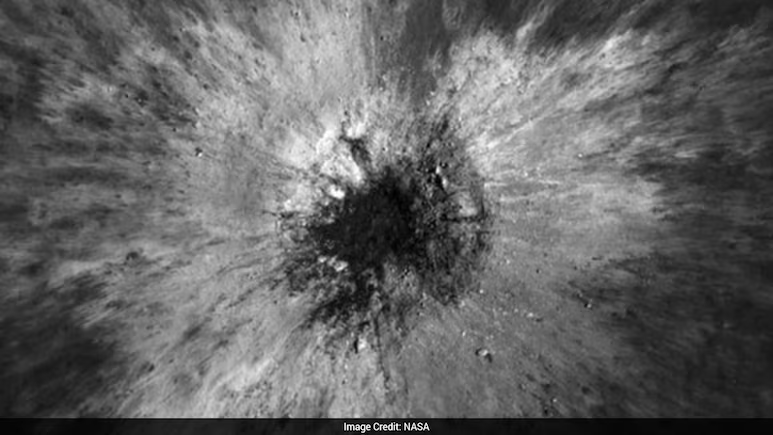
A routine review of lunar images has led to a remarkable discovery: scientists working with NASA’s Lunar Reconnaissance Orbiter have identified a huge crater that formed on the Moon during a powerful impact in 2024.
Named McGetchin crater, the newly identified feature is around 728 feet (222 metres) wide and can reach approximately 141 feet (43 metres) in depth. Scientists say it is the largest newly formed impact crater identified in the solar system in recent times.
The discovery offers researchers an unusual opportunity to study a fresh lunar impact and understand how collisions with space rocks continue to reshape the Moon.
Related Post
How Scientists Found the New Crater
The discovery began with a routine review of data from the Moon.
Robert Wagner, an image-processing specialist from Intuitive Machines who works with NASA’s Lunar Reconnaissance Orbiter Camera system, was examining lunar maps when he noticed an unusually bright area surrounded by a darker halo.
The pattern suggested that something had recently disturbed the lunar surface.
Wagner then compared images captured before and after the suspected event. The comparison revealed a significant change that had not previously been identified as a new crater. NASA says the crater stood out because of the extensive debris pattern surrounding the impact site.
The finding demonstrates the importance of comparing lunar images taken at different times. Because the Moon has no atmosphere comparable to Earth’s and experiences constant impacts from space debris, its surface preserves evidence of collisions for scientists to examine.
When Did the Moon Impact Happen?
Researchers have narrowed the formation of McGetchin crater to a period between April 11 and May 22, 2024.
The crater was therefore already present for more than a year before scientists identified it through detailed analysis of Lunar Reconnaissance Orbiter imagery.
The impact is believed to have been caused by an asteroid or comet fragment roughly comparable in size to a three- to six-storey building. Despite the object’s relatively modest size compared with large asteroids, the collision produced a crater more than 200 metres across.
A Rare Lunar Event
Large impacts do happen on the Moon, but an event capable of producing a crater of this size is considered uncommon.
Scientists estimate that an impact of this magnitude could occur roughly once every century or longer. Other reporting on the research puts the estimated interval at around 132 years, highlighting just how unusual it is for researchers to observe such an event during the lifetime of a spacecraft mission.
For scientists, the timing is particularly valuable. Instead of studying an ancient crater whose original characteristics have been altered over millions or billions of years, researchers can examine a relatively fresh impact and its surrounding debris.
Why the McGetchin Crater Matters
The Moon’s surface may appear largely unchanged from Earth, but it is continually modified by impacts from meteoroids, asteroids and comet fragments.
A newly formed crater gives scientists a chance to study these processes almost immediately on geological timescales.
According to NASA, the impact that created McGetchin crater disturbed lunar material across an area extending more than 100 kilometres. Researchers can use the distribution of this material to investigate how debris travels across the lunar surface after an impact.
The crater is also important because future lunar missions will operate in an environment where impacts remain a potential hazard. Better knowledge of how often significant impacts occur and how far debris can travel can contribute to planning for future lunar infrastructure.
NASA's Lunar Reconnaissance Orbiter Continues to Watch the Moon
NASA’s Lunar Reconnaissance Orbiter (LRO) has been studying the Moon for more than 17 years.
The spacecraft carries seven instruments designed to investigate the lunar surface, composition, temperature and radiation environment. Its cameras have provided scientists with an enormous collection of images that can be compared over time to identify changes on the Moon.
Researchers have already identified thousands of new impact craters and many additional surface changes using LRO data.
The McGetchin discovery shows why long-running lunar missions remain valuable. A spacecraft that repeatedly photographs the same world can effectively create a time-lapse record of how its surface changes.
Named After Lunar Scientist Tom McGetchin
The newly identified crater has been officially named McGetchin, honouring lunar scientist Tom McGetchin.
The name adds another connection between modern lunar exploration and the scientists who helped build the foundations of Moon research.
The discovery itself was not the result of a new spacecraft arriving at the Moon. Instead, it came from careful analysis of existing observations and comparisons between images collected at different times.
That detail is significant. Modern space science increasingly relies not only on new missions but also on extracting new information from large datasets gathered by missions already operating for years.
What This Discovery Tells Us About the Moon
The fresh crater is another reminder that the Moon is not a completely static world.
Its surface continues to be affected by impacts from objects travelling through space. Because the Moon has no substantial atmosphere to burn up incoming small objects and no weather system to rapidly erase surface features, many of these impacts leave visible evidence behind.
McGetchin provides researchers with a relatively recent example of this process.
By studying its size, depth, surrounding debris and the area affected by the impact, scientists can improve their understanding of lunar geology and the consequences of high-speed collisions.
As countries and commercial companies prepare for more activity around the Moon, such knowledge could become increasingly important.

A Rare Window Into the Moon's Changing Surface
The discovery of McGetchin crater is significant not simply because of its size, but because scientists have been able to identify a comparatively recent impact and examine its aftermath using detailed spacecraft imagery.
For future lunar exploration, observations like these can help scientists better understand the environment astronauts, spacecraft and infrastructure will encounter.
The Moon may have been formed billions of years ago, but discoveries such as this show that its story is still being written.
Source: NASA Science, Lunar and Planetary Institute, and published reporting on the Science Advances research.
Disclaimer: This article is based on information available from NASA and published reports at the time of writing. Scientific findings and measurements may be updated as further research becomes available.