
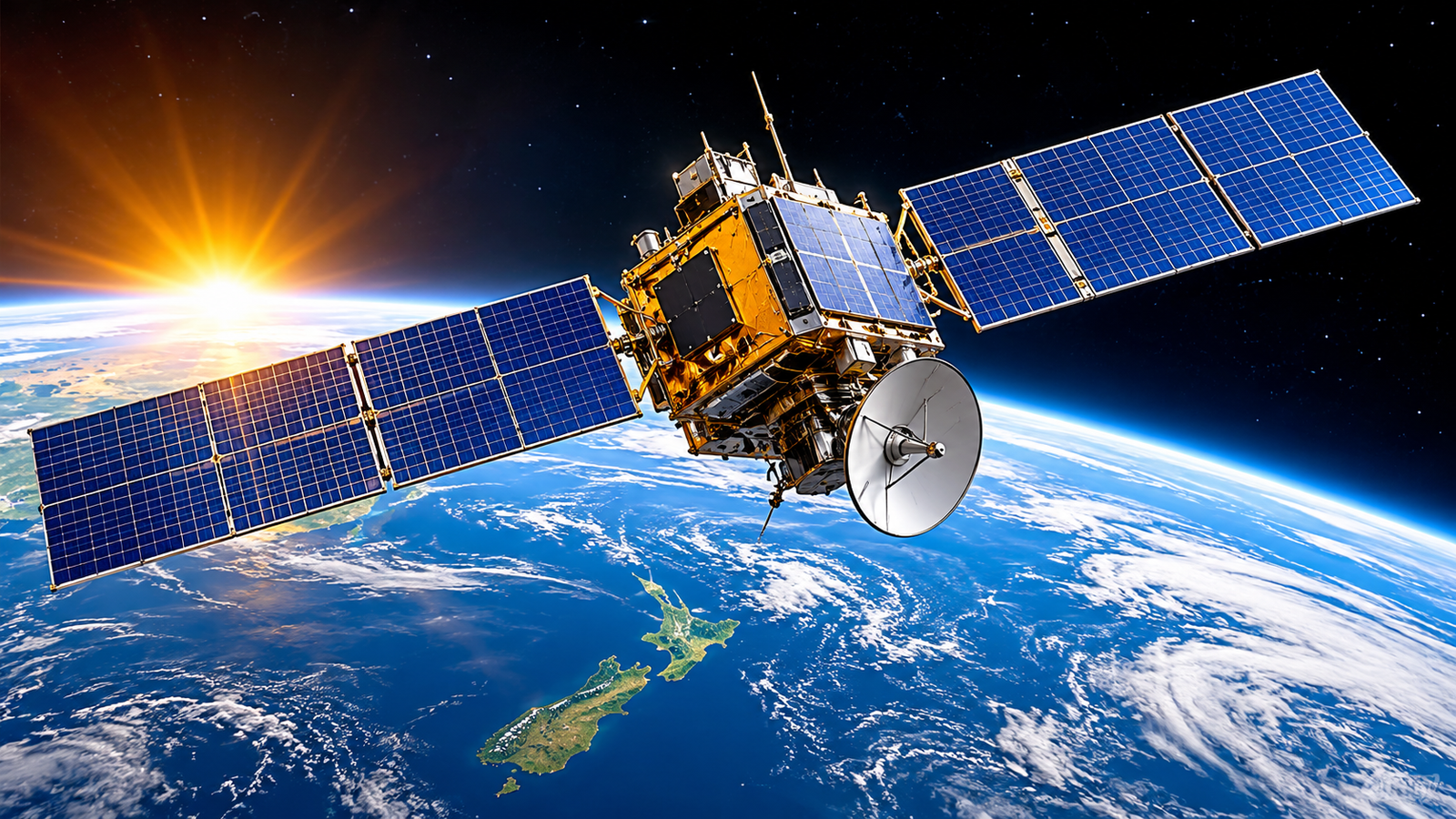
Google has taken an important step towards space-based artificial intelligence after successfully running its Gemma AI model on a satellite in orbit. The experiment marks an early milestone in the company’s ambitious plan to explore whether future AI computing infrastructure could operate beyond Earth.
The test is part of Project Suncatcher, Google’s long-term research initiative investigating solar-powered satellites equipped with specialised AI processors. Rather than relying entirely on traditional data centres on Earth, the project explores a future in which networks of satellites could process AI workloads in space.
For the technology industry, this development raises an interesting question: could some of the computing infrastructure powering tomorrow’s AI services eventually move into orbit?
Related Post




Google Successfully Runs an AI Model on a Satellite
In late October 2026, Google’s experimental satellite demonstrated that an AI model could run on onboard computing hardware and return a response to a request sent from Earth.
The satellite carried four Google Tensor Processing Units, commonly known as TPUs, designed to accelerate machine-learning workloads. During the experiment, Google ran its Gemma 4 model onboard and received an AI-generated response back on Earth.
The demonstration included a request for a short poem about space. While the creative output was a simple test, the underlying achievement was more significant: the team was able to run an AI workload on a satellite and communicate its response back to the ground.
The spacecraft was developed with Planet Labs and launched in October 2026 as part of a SpaceX rideshare mission.
However, this remains an experimental demonstration rather than a fully operational orbital data centre. Engineers still need to establish how reliably the hardware can work under the demanding conditions of space.
What Is Google Project Suncatcher?
Project Suncatcher is Google’s research effort to investigate whether machine-learning infrastructure could eventually be built around networks of satellites.
The concept involves placing AI processors on satellites that operate in low Earth orbit. These satellites could use solar panels to generate electricity and optical links, including laser communications, to exchange data with other spacecraft.
In a future configuration, multiple satellites could work together to process larger AI workloads, creating a distributed computing system above Earth.
Google introduced the initiative in November 2025 and subsequently outlined its plans for prototype testing and further technical research.
The project is still in its early stages. Its purpose is to test the fundamental technologies required for space-based computing before any large-scale deployment becomes realistic.
Why Put AI Data Centres in Space?
The growing use of artificial intelligence has increased demand for computing power, electricity, cooling systems and data-centre infrastructure. Technology companies are therefore investigating alternative ways to supply the resources required by increasingly demanding AI applications.
Space offers a different set of opportunities.
1. Access to solar energy
Satellites in carefully selected orbits can receive sunlight for much of their orbital journey. A future satellite network designed around these conditions could potentially generate substantial amounts of solar electricity.
Consistent solar exposure could reduce reliance on large onboard batteries and make certain orbital computing designs attractive.
However, collecting solar energy is only one part of the equation. The electricity must be generated, converted, distributed and used efficiently by the onboard processors.
2. New possibilities for computing infrastructure
Traditional data centres require buildings, electrical connections, cooling equipment and physical space. In orbit, computing infrastructure would operate under a different set of physical and engineering constraints.
A satellite-based system might eventually support specialised workloads, particularly where processing data close to its source is beneficial.
For example, future systems could potentially analyse satellite imagery in orbit before sending selected results to Earth. This could reduce the need to transmit some raw data, depending on the application and communication requirements.
3. Potential to reduce pressure on terrestrial resources
Large data centres can place significant demands on local electricity networks, land and cooling infrastructure.
Space-based computing is being explored as a possible additional option for meeting future computing needs. However, it is too early to conclude that orbital systems will be cheaper or environmentally better than ground-based alternatives.
Rocket launches, satellite manufacturing, replacements and specialised thermal systems all have costs and environmental implications.
The Biggest Challenges Facing AI in Space
Although Google’s latest demonstration is an encouraging milestone, building a practical orbital data centre involves several difficult engineering problems.
Radiation and hardware reliability
Earth’s atmosphere and magnetic environment provide protection against many forms of space radiation. Satellites face greater exposure to energetic particles that can interfere with electronic components.
Radiation can cause errors in computer memory and calculations, potentially affecting the reliability of AI workloads. Google’s researchers have conducted ground-based radiation tests, but real orbital operation provides additional information about how the processors behave over time.
Long-term reliability will be essential if future satellites are expected to perform useful computing tasks continuously.
Cooling powerful AI processors
Cooling is another major challenge.
On Earth, data centres can use fans, liquid cooling and other systems to move heat away from processors. In the vacuum of space, conventional airflow cooling is not available.
Heat must instead be managed through methods such as conduction, heat pipes and radiators that release thermal energy into space.
AI processors can generate substantial heat in a compact area. Engineers must therefore balance computing performance with the amount of heat a satellite can safely remove.
The current experiment is designed to help researchers understand these practical limitations.
Communication between satellites
An orbital computing network would need to move data between satellites and communicate with ground stations.
Google has proposed using high-speed optical links, including laser-based connections, to support communication between closely coordinated spacecraft.
Developing these connections is challenging because satellites move rapidly relative to Earth and must maintain accurate alignment. Future systems would also need sufficient bandwidth and reliability to distribute AI workloads effectively.
Google has identified interconnected satellite testing as a key step towards its longer-term ambitions.
Launch costs and maintenance
Sending specialised equipment into orbit remains expensive. Satellites also have limited lifetimes and can be difficult or impossible to repair economically once deployed.
A large computing network would require launches, power systems, communications equipment, thermal management and strategies for replacing failed components.
For orbital data centres to become commercially competitive, improvements in launch costs, satellite manufacturing and system efficiency would be essential.