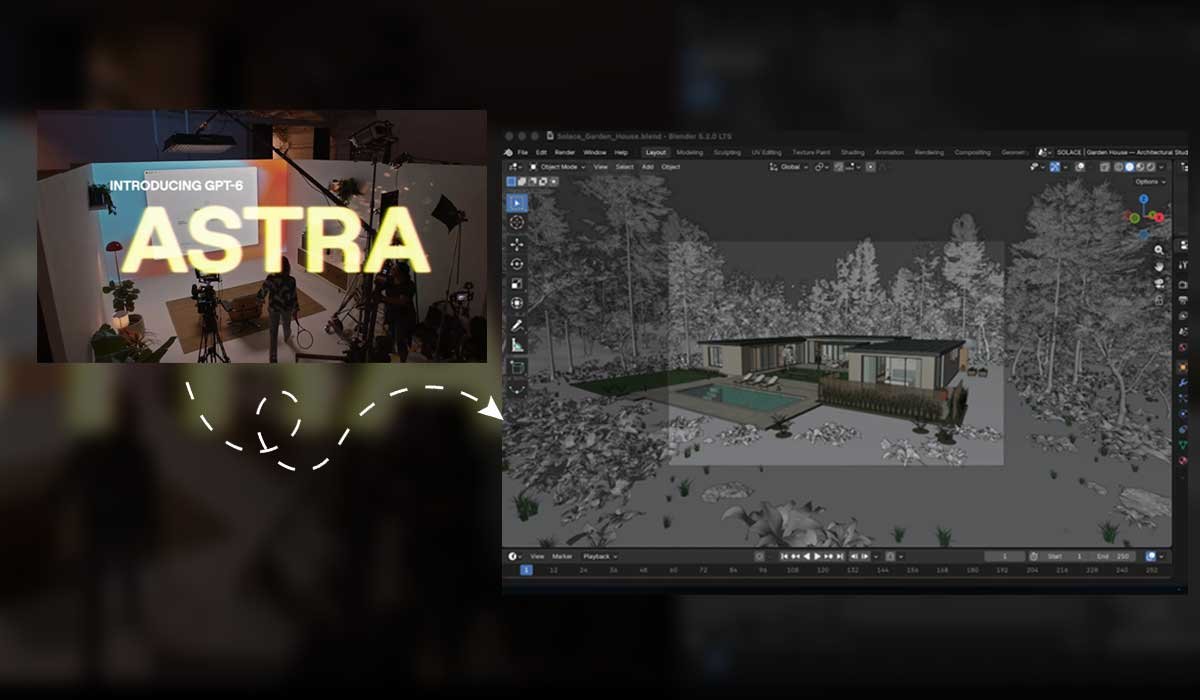
Artificial intelligence is moving deeper into the gaming industry, and OpenAI’s latest GPT-6 Astra could give game developers a powerful new way to build, test and improve games.
Game development has traditionally required teams of programmers, designers, artists, testers and technical specialists. Creating even a small playable game can involve writing thousands of lines of code, designing environments, building interfaces, testing gameplay and fixing bugs.
GPT-6 Astra could change parts of this process by combining advanced reasoning, software engineering and computer-use capabilities. OpenAI says Astra can work across code, browsers and software environments, while its game-development examples demonstrate the ability to create interactive games from prompts.
Related Post
What Is GPT-6 Astra?
GPT-6 Astra is OpenAI’s latest-generation AI model, introduced in September 2026. The company describes it as its most intelligent model, with improvements in computer use, software engineering, browsing, science and professional workflows.
One important difference is that Astra is designed not only to generate an answer or piece of code but also to handle multi-step computer tasks.
For game development, that distinction could be significant.
Instead of simply asking AI to write a function, a developer can potentially use it as part of a workflow that involves creating assets or code, making changes inside development software, testing the result and identifying problems.
OpenAI’s own examples include game-development workflows and an interactive kart-racing game created with Astra.
How Could GPT-6 Astra Help Game Developers?
1. Faster Game Prototyping
One of the biggest opportunities is rapid prototyping.
A developer may have an idea for a racing game, platformer, puzzle game or adventure game but traditionally needs significant time to turn that idea into something playable.
With an advanced AI model, the developer can describe the basic concept and use AI assistance to create an initial prototype.
For example:
“Create a simple 3D racing game with three tracks, vehicle controls, checkpoints and a lap timer.”
The AI can then assist with the programming and development workflow.
The important benefit is not necessarily creating a finished commercial game instantly. Instead, developers can get to a playable version of an idea much faster.
That allows teams to test whether an idea is actually fun before investing significant development resources.
2. Turning One Prototype Into Multiple Game Concepts
OpenAI highlighted an example from Playco, which used GPT-6 Astra to create three themed game prototypes from a shared grey-box foundation.
According to Playco, the team also saw a 50% reduction in manual fixes compared with its previous model. The company reported improvements in spatial reasoning, recreating visual references and responsive game interfaces.
This could be particularly useful for early-stage game design.
A developer could start with one basic environment and then experiment with different themes.
For example:
- Fantasy world
- Cyberpunk city
- Space station
- Ancient civilisation
- Futuristic racing environment
Instead of rebuilding every version manually, AI could help developers explore multiple directions quickly.
3. Helping With Game Code
Game development involves many different programming tasks.
Developers may need code for:
- Player movement
- Character controls
- Enemy behaviour
- Scoring systems
- Inventory systems
- Menus
- Physics
- Saving and loading
- Multiplayer features
- Game progression
- User interfaces
GPT-6 Astra is designed to perform advanced software-engineering tasks, which means it can potentially assist developers with writing, understanding and debugging these systems.
This does not mean developers become unnecessary.
Instead, AI can act as a development assistant that helps programmers spend more time on game design and creative decisions.
4. Testing the Game
Testing is one of the most time-consuming parts of game development.
A game may appear to work correctly but contain bugs that only appear after a player performs a particular sequence of actions.
AI-assisted development could make testing more continuous.
For example, an AI agent could help:
- Build a feature.
- Launch the game.
- Interact with the game.
- Identify an unexpected behaviour.
- Investigate the underlying code.
- Suggest or implement a fix.
- Test the change again.
OpenAI says Astra’s computer-use capabilities allow it to work directly with software environments and test workflows rather than being limited to producing text.
For game developers, this could shorten the distance between writing code and seeing whether that code actually works.
5. Better Understanding of Game Environments
Game development is not only about programming.
Spatial positioning is extremely important.
Characters need to stand in the right place. Menus need to fit correctly on screen. Objects need to interact properly. Levels need to feel balanced.
Playco specifically reported improvements with GPT-6 Astra in spatial reasoning and positioning elements inside game environments.
That could make AI assistance more useful for developers working with 2D and 3D environments.
6. Helping Non-Programmers Create Games
Perhaps the most interesting possibility is what Astra could mean for people who do not know how to code.
A person with a game idea could potentially describe what they want in natural language.
For example:
“Create a simple mobile puzzle game where players arrange coloured tiles to complete patterns.”
AI could help translate that description into the technical components required for a prototype.
This lowers one of the traditional barriers to game development: programming knowledge.
However, creating a prototype is very different from creating a polished commercial game.
Professional games still require careful design, optimisation, testing, art direction, sound, security and human decision-making.
7. Helping With Game Design Iterations
Game developers often need to experiment.
What if the player moves faster?
What if the level is smaller?
What if enemies appear earlier?
What if the user interface is redesigned?
What if the game becomes a multiplayer experience?
AI can potentially help developers make these iterations faster.
Instead of spending days building every experimental version, teams could use AI-assisted workflows to test different possibilities and decide which direction is worth pursuing.
This could encourage more experimentation during development.

GPT-6 Astra Does Not Replace Game Developers
Despite the excitement around AI-generated games, it would be a mistake to assume that GPT-6 Astra can completely replace professional game-development teams.
A successful game requires much more than working code.
It needs:
- A strong gameplay concept
- Good level design
- Art direction
- Sound design
- Storytelling where appropriate
- Performance optimisation
- Player testing
- Original creative ideas
- Security
- Quality assurance
- Business and publishing decisions
AI can help accelerate many technical tasks, but humans still need to decide what game should be made and why players should care about it.
There is also an important legal consideration.
Developers should not use AI to reproduce copyrighted characters, assets, levels or game designs without permission. A recent case involving an AI-built game that closely copied elements of RuneScape demonstrates the potential legal and ethical problems of treating existing games as material to reproduce.
What Could This Mean for Indie Game Developers?
The impact could be especially significant for independent developers.
Large studios can employ programmers, artists, designers and QA teams. Independent developers often work with much smaller teams.
AI assistance could help small teams handle a wider range of tasks.
A solo developer might use AI assistance for:
Idea → Prototype → Code → Testing → Improvements
This could make experimentation considerably cheaper and faster.
It could also allow developers to focus their limited time on the creative elements that differentiate their games.
The Future: From AI Assistant to AI Development Partner?
The biggest change may be the shift from AI as a simple coding assistant to AI as an active development partner.
Traditional AI coding tools primarily respond to instructions such as:
“Write this function.”
More advanced systems can participate in larger workflows:
“Build this feature, test it, find problems and improve it.”
GPT-6 Astra is designed around this broader type of computer-use and software-engineering capability. OpenAI says Astra can carry out multi-step workflows and has demonstrated its capabilities across game development and other software environments.
That could eventually change how game-development teams organise their work.
What Should Developers Keep in Mind?
AI can accelerate development, but developers should still review everything it produces.
Important areas include:
- Code quality
- Security vulnerabilities
- Performance
- Game balance
- Copyright and intellectual property
- Player privacy
- Originality
- Compatibility across devices
Developers should also test AI-generated changes themselves rather than assuming that a working prototype is production-ready.
GPT-6 Astra represents an important development in AI-assisted game creation.
Its combination of coding, reasoning, computer use and visual capabilities could help developers move from an idea to a playable prototype faster than before. OpenAI’s own game-development demonstrations and Playco’s reported experience suggest that AI can already contribute to prototyping, testing, spatial reasoning and iterative development.
But the most exciting possibility may not be AI creating games completely on its own.
It may be AI helping more people turn their ideas into games.
For professional studios, that could mean faster development cycles. For indie developers, it could mean doing more with smaller teams. And for beginners, it could provide a new way to experiment with game development without needing to master every technical skill first.
The future of game development may therefore be less about AI replacing developers and more about developers using AI to build, test and imagine more ambitious games.
For more technology, AI and digital innovation updates, explore the Technology Desk on NZ Indian Insights.
Disclaimer: This article is for general informational purposes. AI capabilities, availability and performance can change as models and tools are updated. Developers should independently review AI-generated code, content and assets before using them in production.