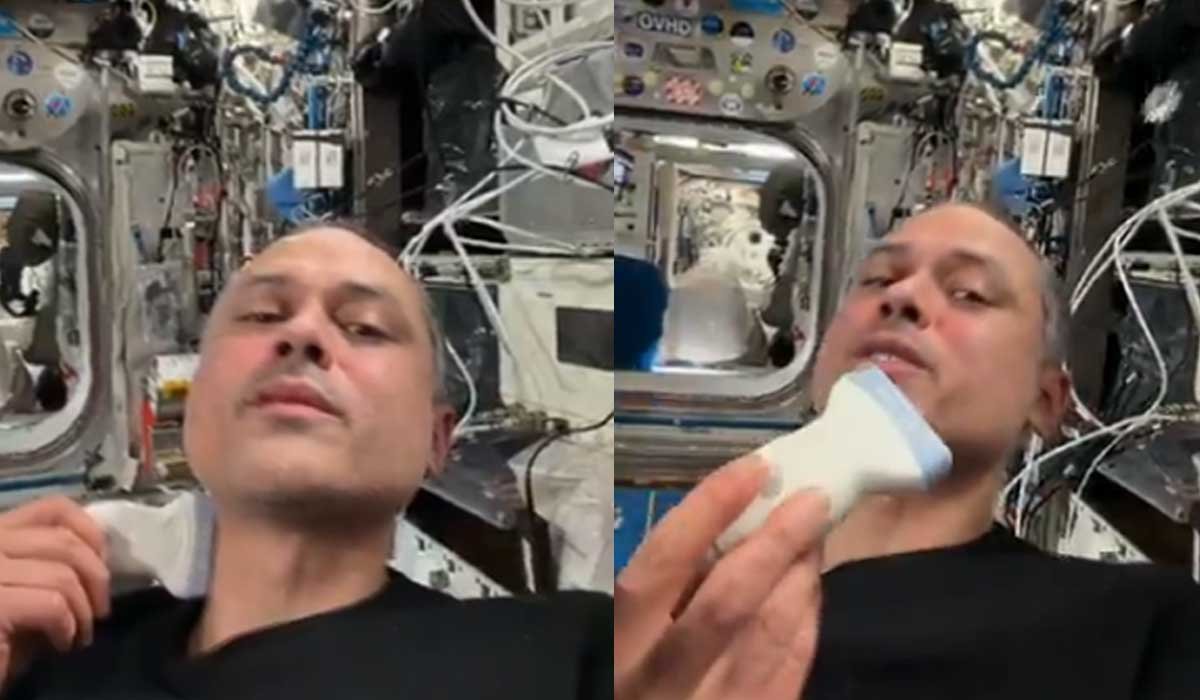
Medical testing takes on a completely different meaning when it is carried out hundreds of kilometres above Earth.
NASA astronaut Anil Menon has offered a glimpse into how astronauts and medical teams work together to conduct health-related research aboard the International Space Station (ISS), showing how ultrasound technology, teamwork and doctors on Earth can help monitor the human body in microgravity.
In a recent demonstration, Menon showed how an ultrasound examination can involve more than one astronaut, with one crew member operating the ultrasound equipment while another manages controls. A remote guider and doctors on Earth can then assist the crew in obtaining useful images and assessing the results.
Related Post
The work is part of a wider effort to understand how spaceflight affects the human body and how astronauts can remain healthy during increasingly longer missions.
This is how we do science on the @Space_Station. In this demonstration, we have one person operating the ultrasound and the other person operating the controls.
— Anil Menon (@astro_anil) September 9, 2026
A remote guider and a team of doctors make sure that we’re getting the right images and also analyzing the images… pic.twitter.com/iKZZ8b4DTF
Why Medical Testing Is Different in Space
On Earth, medical examinations usually take place in hospitals, clinics or doctors’ offices where trained specialists and sophisticated equipment are readily available.
In space, astronauts have to work within a very different environment.
The International Space Station operates in microgravity, where the human body experiences changes that do not occur in the same way on Earth. Blood and other body fluids can shift, and researchers are studying how these changes affect astronauts’ health during extended periods in orbit.
This makes regular medical monitoring an important part of life aboard the station.
NASA has reported that Menon and other crew members have been conducting vein scans using the Ultrasound 3 biomedical device, with doctors on the ground monitoring the examinations in real time. The research is helping scientists understand how weightlessness affects blood flow and the circulatory system.
Anil Menon's Ultrasound Demonstration
Menon’s recent demonstration highlights the teamwork required to perform medical procedures in orbit.
An ultrasound examination might appear straightforward on Earth, but performing one in microgravity requires careful coordination.
During the demonstration described by Menon, one astronaut operates the ultrasound while another manages the equipment controls. Meanwhile, a remote guide and medical professionals on Earth help make sure the appropriate images are captured.
This creates a medical research process connecting the ISS with teams on Earth.
The ability to receive guidance from specialists is particularly valuable because astronauts are not expected to be experts in every medical procedure they may need to perform.
Instead, space missions combine astronaut training with remote expertise and specialised technology.
What Is Microgravity Doing to the Human Body?
Microgravity can change the way blood moves through the body.
Researchers are particularly interested in the circulatory system because changes in blood flow could create health risks during spaceflight.
NASA has been using ultrasound examinations to study astronauts’ veins and blood flow while they are in orbit. The information gathered can help scientists better understand space-related changes and identify potential risks.
Menon himself has participated in these examinations. NASA reported in August that he operated the Ultrasound 3 device to scan a fellow astronaut’s veins and measure blood pressure while doctors on the ground monitored the procedure in real time.
In another activity, fellow crew members used the ultrasound equipment to scan Menon’s veins while researchers monitored the process from Earth.
These repeated examinations allow researchers to build a broader picture of how astronauts’ bodies respond during long-duration missions.
Blood Samples Are Also Part of the Research
Medical research aboard the ISS is not limited to ultrasound.
Astronauts also collect and process blood samples as part of investigations into the effects of spaceflight.
NASA has reported that Menon has collected blood samples, processed them using a centrifuge and preserved them for later analysis. Some of this work is connected to research into cellular immune function and how the body responds to the space environment.
Blood samples can provide researchers with valuable information about physiological changes that may not be visible from the outside.
Together with imaging, blood-pressure measurements and other assessments, these tests give scientists a more complete understanding of astronaut health.
Why Doctors on Earth Remain Important
One of the most interesting elements of medical research aboard the ISS is the connection between astronauts and doctors on Earth.
Astronauts may be operating equipment inside the station, but they are not working completely alone.
Ground-based medical specialists can monitor procedures, provide guidance and assess information as it becomes available.
NASA recently described an Ultrasound 3 session in which doctors on Earth provided real-time assistance while astronauts carried out vein scans.
This model could become even more important as humans prepare for missions beyond low Earth orbit.
Preparing for Longer Missions
The ISS is an important testing environment for future human exploration.
A mission to the Moon could keep astronauts away from Earth for extended periods. A future journey to Mars would present an even greater challenge because astronauts would be much farther away and could not rely on the same level of immediate support.
NASA has said Menon’s mission includes research designed to improve medical capabilities for future space exploration.
Among the technologies being investigated are ultrasound approaches using augmented reality and artificial intelligence. NASA says these technologies could eventually help reduce the need for medical support from Earth during future missions.
That could become critical when astronauts travel to destinations where communication delays make real-time medical guidance difficult.
Could AI Help Astronauts With Medical Tests?
Artificial intelligence could become an important part of future space medicine.
Today, astronauts can receive support from specialists on Earth. But a crew travelling much farther from Earth may need to perform more medical procedures independently.
AI-assisted systems could potentially help astronauts capture useful medical images, identify patterns and provide decision-support information.
Menon’s mission includes work exploring ultrasound with augmented reality and AI methods, according to NASA. The long-term objective is to develop medical capabilities that could be more independent from Earth-based support.
The combination of AI, medical imaging and astronaut training could therefore become an important component of future exploration.
Anil Menon's Medical Background
Menon’s involvement in this research is particularly significant because of his professional background.
Before becoming a NASA astronaut, Menon worked as an emergency medicine physician and flight surgeon. His medical and engineering experience provides a useful combination for a mission involving both human health research and complex space operations.
NASA selected Menon as part of its 2021 astronaut class.
He launched aboard the Soyuz MS-29 spacecraft in July 2026 and joined the International Space Station as part of the Expedition 74/75 crew. NASA says his mission includes scientific research and technology demonstrations aimed at advancing human space exploration and producing benefits on Earth.
Space Medicine Could Benefit Earth
Research carried out in space is not only about protecting astronauts.
Some of the knowledge gained from studying human health in microgravity could also contribute to medical research on Earth.
Understanding blood flow, vascular changes, immune responses and other physiological processes can provide scientists with information about the human body under unusual conditions.
NASA has also highlighted the potential for space-based research to advance health on Earth.
Medical technologies designed to operate with limited resources could eventually be useful in remote locations or situations where specialist medical support is not immediately available.
The Bigger Picture
Anil Menon’s demonstration may look like a simple medical examination, but it represents a much bigger challenge facing human space exploration.
The farther humans travel from Earth, the more medical independence they will need.
Astronauts cannot take an entire hospital with them. Instead, future crews will need compact equipment, advanced diagnostics, reliable communication systems and increasingly intelligent technologies.
Research aboard the ISS is helping scientists develop that capability step by step.
Menon’s work demonstrates how astronauts can perform medical tests while doctors and researchers on Earth remain connected to the process. It also shows why understanding the effects of microgravity on the human body is essential before sending crews on longer journeys.

Looking Beyond the International Space Station
The International Space Station continues to serve as a laboratory for understanding how humans live and work in space.
For astronauts such as Anil Menon, medical research is an important part of that mission.
From ultrasound scans and blood-pressure measurements to blood-sample analysis and new AI-assisted medical technologies, researchers are building knowledge that could help protect astronauts on future missions.
As humanity looks toward longer stays on the Moon and eventual missions to Mars, the ability to conduct reliable medical tests away from Earth could become just as important as propulsion, communication and life-support systems.
Anil Menon’s work offers a fascinating look at that future — where doctors may be thousands or millions of kilometres away, but technology could allow astronauts to continue monitoring their health with increasing independence.
The future of space exploration will not only depend on how far humans can travel, but also on how well they can look after themselves when Earth is far away.