Imagine looking up at the night sky and thinking:
“One day, India should reach beyond Earth too.”
At a time when India was still developing as a young nation, this was not an ordinary thought.
Related Post
It was a vision.
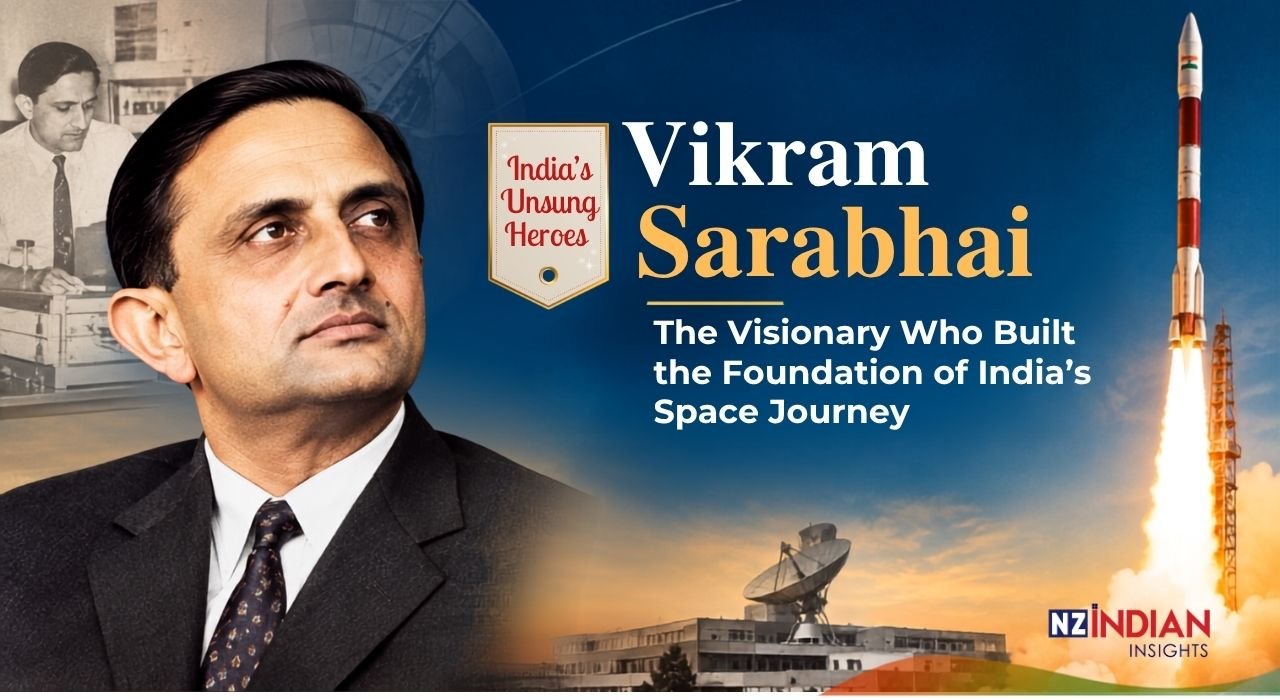
And behind that vision was Dr. Vikram Ambalal Sarabhai, a scientist, institution builder and one of the key figures who laid the foundation for India’s space programme.
A Vision Bigger Than Rockets
When people think about space exploration, they often picture rockets launching into the sky, satellites orbiting Earth and astronauts travelling into space.
But building a space programme requires much more than rockets.
It requires scientists, engineers, research institutions, technology, education and, most importantly, a long-term vision.
Vikram Sarabhai understood this.
He believed that advanced space technology should not simply be about prestige or competing with other nations. He saw something much more practical.
He believed space technology could help solve real problems on Earth.
From communication and education to weather forecasting and remote sensing, he saw the potential for space science to support India’s development.
From Curiosity to Science
Born in Ahmedabad in 1919, Sarabhai developed an interest in science from an early age.
He studied at the University of Cambridge and later became involved in scientific research in India.
His early work focused on cosmic rays and scientific research, but his ambitions extended far beyond his own research.
He wanted India to build its own scientific capabilities.
That meant creating places where Indian scientists and engineers could learn, experiment and develop new technologies.
Building the Foundations of India’s Space Programme
In 1962, the Indian National Committee for Space Research (INCOSPAR) was established under the leadership of Sarabhai.
This marked an important step towards organised space research in India.
One of the most significant developments came at Thumba, near Thiruvananthapuram in Kerala.
The location was chosen because of its proximity to the Earth’s magnetic equator, making it particularly useful for certain scientific studies involving atmospheric and space phenomena.
From this modest beginning, India started developing its capability to launch scientific rockets and conduct space research.
What started with small sounding rockets would eventually grow into one of the world’s major space programmes.
The Birth of ISRO
In 1969, the Indian Space Research Organisation (ISRO) was established.
Sarabhai played a central role in shaping the organisation and its vision.
His approach was different from simply trying to prove that India could send rockets into space.
He wanted space technology to have a purpose.
He famously emphasised the importance of using advanced technologies to address the real problems faced by people.
That philosophy became an important part of India’s space programme.
Space Technology for Everyday Life
Sarabhai saw possibilities that went beyond scientific exploration.
Satellites could help connect people across a large country.
They could support education in areas where access to schools and teachers was limited.
They could provide information about weather and help with disaster management.
They could also help scientists study agriculture, forests, water resources and the Earth’s surface.
In other words, Sarabhai did not see space as something far away from everyday life.
He saw it as a tool that could improve life on Earth.
More Than a Space Scientist
Sarabhai’s contribution was not limited to India’s space programme.
He was involved in establishing and developing several important scientific, educational and industrial institutions.
He helped create a culture in which scientific research, innovation and education could grow together.
His work contributed to institutions such as the Physical Research Laboratory (PRL) and the Indian Institute of Management Ahmedabad (IIMA), among others.
His legacy therefore extends beyond space science.
It is also about building institutions and creating opportunities for future generations.
The Beginning of Something Much Bigge
Vikram Sarabhai passed away in 1971, at just 52 years of age.
He did not live to see many of the achievements that India’s space programme would eventually accomplish.
He did not see the later generations of Indian launch vehicles and satellites.
He did not see India send missions to the Moon and Mars.
But the foundations he helped establish continued to grow.
Decades later, India’s space programme would achieve milestones that once seemed almost impossible.
And behind many of those achievements was the institutional and scientific foundation built during the early years.
Why Vikram Sarabhai Is an Unsung Hero
Today, many people know the names of famous space missions.
But fewer people know the story of the person who helped create the vision behind India’s space journey.
Sarabhai’s greatest contribution was not one particular rocket or satellite.
It was the belief that India could build its own scientific future.
He helped bring together scientists, engineers, institutions and ideas at a time when resources were limited and the challenges were enormous.
He showed that innovation does not always begin with having everything you need.
Sometimes, it begins with asking:
“What can we build with what we have?”
A Lesson for the Next Generation
Vikram Sarabhai’s story offers a powerful lesson for young Indians around the world.
Innovation is not only about creating something new.
It is also about identifying a problem, believing a better solution is possible and building the knowledge and institutions needed to make that solution real.
His vision started with space research.
But its impact reached education, communication, science, technology and national development.
That is why his story continues to matter.

India’s space journey did not begin with a spectacular rocket launch.
It began with a vision.
A vision held by a scientist who believed that a developing nation could use science and technology to build a better future.
Dr. Vikram Sarabhai helped India look beyond the stars while keeping its feet firmly on the ground.
And that is why he deserves a place among India’s Unsung Heroes.
About NZ Indian Insights
India’s Unsung Heroes is a series from NZ Indian Insights celebrating Indians whose ideas, courage, knowledge and contributions have helped shape the world – often without receiving the recognition they deserve.
Because sometimes, the people who change the future are the ones whose names we don’t hear often enough.
FAQs
Who was Vikram Sarabhai?
Vikram Sarabhai was an Indian scientist and institution builder who played a major role in establishing the foundations of India’s space programme.
What is Vikram Sarabhai best known for?
He is best known for developing the vision and institutional foundations of India’s space programme and promoting the practical use of space technology for national development.
What was Vikram Sarabhai’s contribution to ISRO?
Sarabhai played a central role in developing India’s organised space research programme and was instrumental in the establishment of ISRO in 1969.
What was Vikram Sarabhai’s vision for India’s space programme?
He believed space technology should have practical benefits for society, including communication, education, weather forecasting and resource management.
Where did India’s early space research begin?
Thumba in Kerala became an important centre for India’s early space research and sounding-rocket activities.