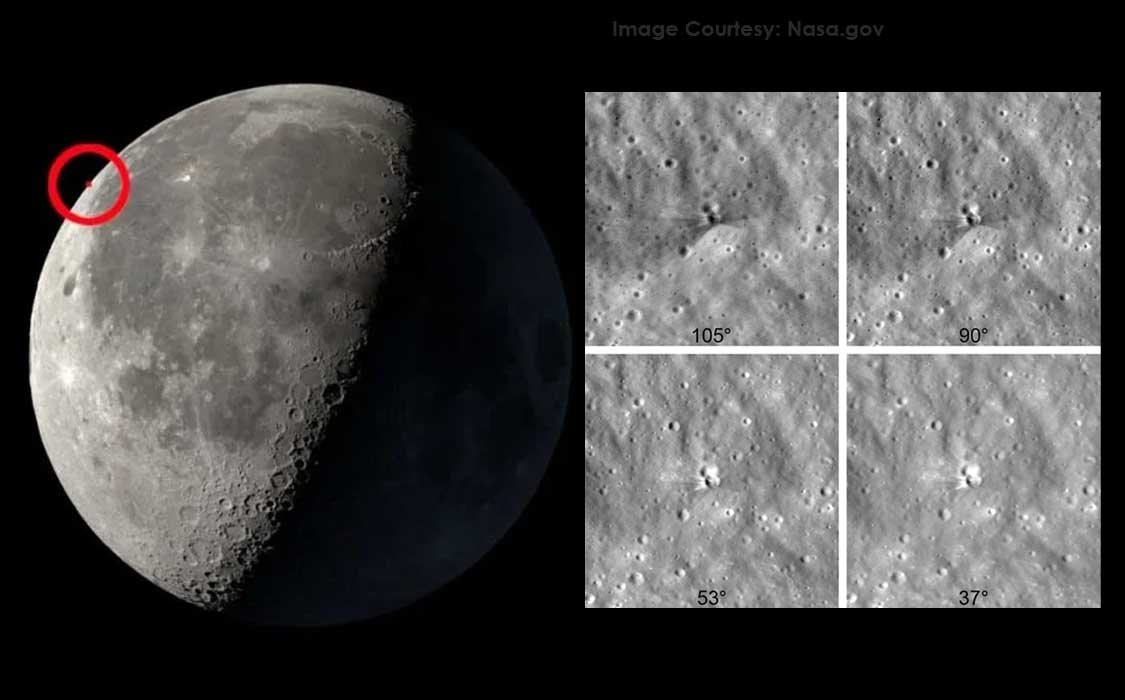
A discarded SpaceX Falcon 9 rocket stage has left a fresh mark on the Moon, and new NASA images are giving scientists a detailed look at the impact site.
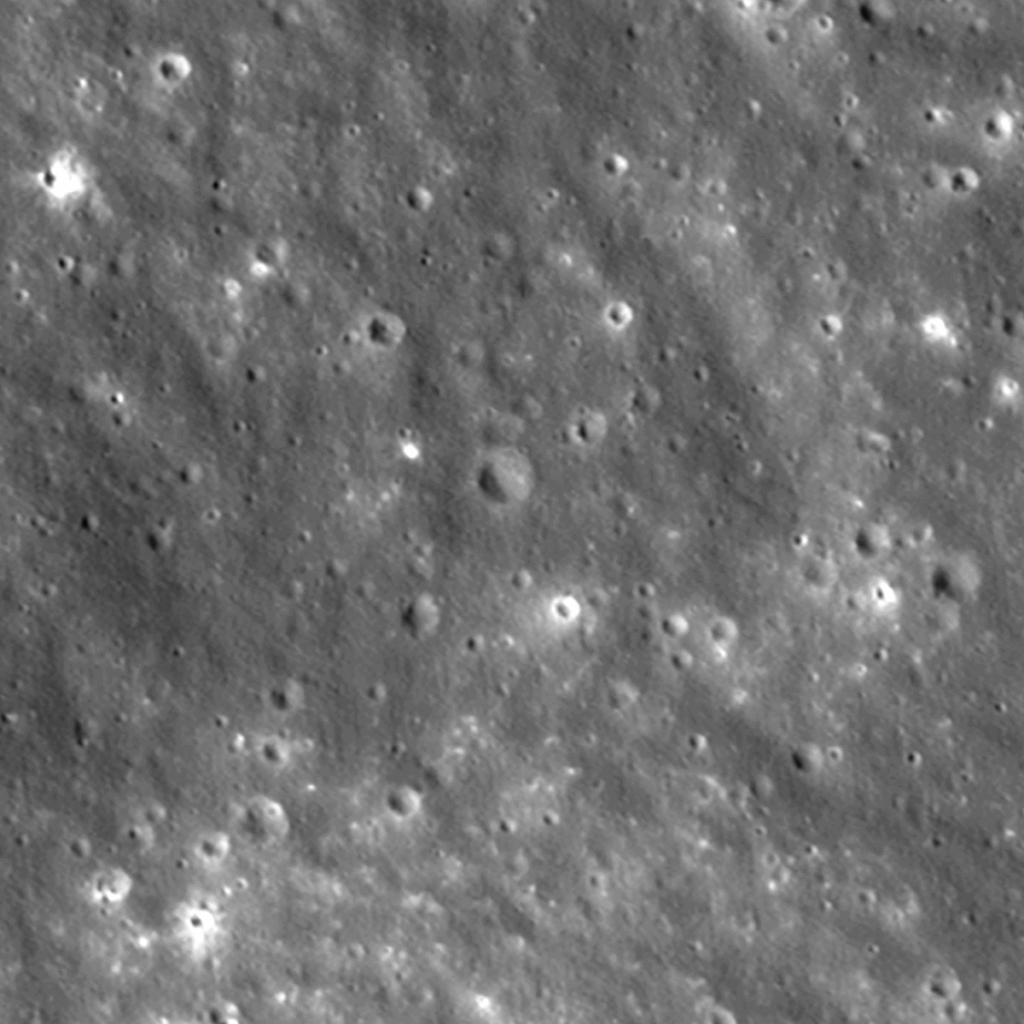
NASA’s Lunar Reconnaissance Orbiter (LRO) captured before-and-after images of the area where the Falcon 9 upper stage struck the lunar surface on August 5, 2026. The spacecraft photographed the site between August 11 and 12, just six days after the collision.
The newly released images show a fresh crater measuring about 60 feet (18 metres) across and less than 10 feet (3 metres) deep. For scientists, the impact provides an unusual opportunity to study how a known human-made object affects the Moon’s surface.
Related Post
SpaceX Rocket Stage Hits the Moon
The object involved was the upper stage of a SpaceX Falcon 9 rocket.
The Falcon 9 launched in January 2025 carrying Firefly Aerospace’s Blue Ghost 1 lunar lander. After completing its role in the mission, the rocket’s upper stage remained in space. Its subsequent trajectory eventually brought it into contact with the Moon.
The impact occurred on August 5, 2026.
Unlike an ordinary spacecraft landing, the rocket stage was not designed to make a controlled landing on the lunar surface. Instead, it travelled toward the Moon before striking the surface at high speed.
NASA had been monitoring the object and its expected trajectory before the impact.
NASA Captures the Fresh Lunar Crater
NASA’s Lunar Reconnaissance Orbiter played a key role in documenting the aftermath.
The spacecraft orbits the Moon approximately every two hours, travelling at around one mile per second. To photograph the new crater, engineers had to carefully adjust the spacecraft’s orientation and timing.
The LRO passed approximately 60 miles above the lunar surface while making its observations.
The timing was particularly challenging. NASA explained that an image captured only 10 seconds too early or too late could have caused the intended target to shift by roughly 10 miles in the camera’s view.
After several days of orbital planning, the spacecraft successfully captured images of the newly created crater.
Crater Measures Around 60 Feet Across
The new images allowed NASA scientists to examine the impact site in detail.
The crater is approximately 60 feet wide and less than 10 feet deep. Researchers estimated its depth by studying the shadow inside the crater.
NASA’s Narrow-Angle Camera aboard LRO was able to capture the feature because the instrument can identify surface details as small as approximately three feet wide.
The crater itself is relatively small compared with many of the Moon’s enormous impact structures, but its recent formation makes it particularly valuable for scientific research.
Scientists know approximately when the impact happened and what type of object caused it. That gives them an opportunity to compare observations with existing impact models.
Bright and Dark Material Surrounds the Impact Site
The images reveal more than simply a hole in the lunar surface.
Researchers observed different shades and patterns surrounding the crater. Some of the darker material had been exposed to the lunar environment for extremely long periods.
The Moon does not have a thick atmosphere like Earth. Its surface is continuously affected by solar wind, cosmic rays and tiny meteoroid impacts.
Over time, these processes alter the appearance and physical characteristics of lunar soil and rocks.
When the Falcon 9 stage struck the surface, it excavated material from below and spread it around the impact area.
Some of the brighter material visible in the NASA images originated deeper beneath the surface and had been protected from long-term exposure to space.
This gives researchers a useful look at material that would normally remain buried.
Why a Human-Made Impact Matters
The Moon has experienced countless natural impacts over billions of years.
Asteroids, meteoroids and other space objects have created the thousands of craters visible across its surface.
However, the Falcon 9 impact is different.
Scientists know the approximate source, size and timing of the object involved. This makes the event useful for studying lunar impact processes.
Researchers can examine the resulting crater and surrounding material and compare what actually happened with theoretical predictions.
Such information could improve scientists’ understanding of how objects interact with the Moon’s surface.
International Cooperation Helped Locate the Site
Finding and documenting the impact site involved more than one organisation.
Astronomers tracked the rocket stage and worked to refine predictions about where it would hit the Moon.
NASA’s Center for Near Earth Object Studies contributed to the trajectory calculations, while observations from South Korea’s Korea Pathfinder Lunar Orbiter, also known as Danuri, helped researchers identify the location.
The cooperation demonstrates how observations from different spacecraft can complement one another.
Once the location was better established, NASA’s Lunar Reconnaissance Orbiter was able to target the area and capture detailed images.

The Moon Has Almost No Atmosphere
The Moon’s extremely thin atmosphere is another important factor in lunar impacts.
Earth’s atmosphere can slow down or destroy many smaller objects before they reach the ground.
The Moon does not have that same protective layer.
Objects travelling toward the lunar surface can therefore hit at very high speeds and release significant amounts of energy when they collide.
The Falcon 9 stage provided another example of how a relatively recent impact can alter the lunar landscape.
What the Images Could Teach Scientists
The new NASA images are valuable because they provide a before-and-after record.
Researchers can compare older photographs of the same area with the new observations and identify exactly what changed.
They can examine:
- The size and shape of the new crater
- The depth of the impact site
- The material thrown outward
- Differences between fresh and weathered lunar soil
- The direction in which material was ejected
- How a human-made object affects the lunar surface
These observations could contribute to future studies of lunar geology and impact physics.
A Growing Challenge for Lunar Exploration
The impact also comes at an important time for space exploration.
The Moon is becoming increasingly important to governments, space agencies and private companies.
More lunar missions are being planned, including robotic landers, scientific instruments, rovers and future human exploration.
As the number of spacecraft travelling to the Moon increases, mission planners will also need to consider what happens to spacecraft after their primary missions are complete.
The Falcon 9 impact highlights how hardware can remain relevant long after its original mission has ended.
While this particular collision did not pose a danger to Earth, it demonstrates why spacecraft trajectory planning and end-of-mission disposal are becoming increasingly important considerations for lunar exploration.
NASA’s LRO Continues to Study the Moon
NASA’s Lunar Reconnaissance Orbiter has been studying the Moon for years, providing high-resolution observations of its surface.
The spacecraft has helped scientists identify craters, study lunar geology and examine areas that could become important for future exploration.
Its ability to capture the Falcon 9 impact site demonstrates the value of maintaining long-term scientific missions around the Moon.
Because LRO already had extensive observations of the lunar surface, scientists could compare the new crater with earlier images of the same region.
A New Human-Made Mark on an Ancient World
The Moon’s surface has been shaped by natural impacts for billions of years.
Now, human activity is adding new features to that ancient landscape.
The Falcon 9 upper-stage impact created a relatively small crater, but the event provides scientists with a rare opportunity to study a fresh impact caused by a known human-made object.
NASA’s new images show the crater and the material surrounding it, allowing researchers to investigate how the lunar surface responded to the collision.
As humanity prepares for a new generation of lunar exploration, the incident serves as both a scientific opportunity and a reminder.
Spacecraft do not necessarily disappear from the story when their missions end. Their trajectories, destinations and eventual disposal can have consequences far beyond their original purpose.
For scientists, the new crater is another piece of evidence that can help explain how the Moon changes.
For the wider space industry, it is a reminder that responsible planning will become increasingly important as activity around the Moon grows.
Disclaimer:
This article is an original news-style rewrite prepared for NZ Indian Insights using publicly available information from NASA and other reported sources. It is intended for general news and informational purposes and does not reproduce the wording or structure of the original source article.
FAQs
When did the SpaceX rocket hit the Moon?
The Falcon 9 upper stage struck the Moon on August 5, 2026.
How large is the crater?
NASA estimates the crater is approximately 60 feet wide and less than 10 feet deep.
Which spacecraft photographed the impact site?
NASA’s Lunar Reconnaissance Orbiter captured detailed images of the crater between August 11 and 12.
Did the impact pose a danger to Earth?
No. The impact occurred on the Moon and did not pose a threat to Earth.
Why is the crater important to scientists?
Because the impacting object was a known human-made spacecraft component, scientists can use the fresh crater and surrounding material to study lunar impact processes.
For more technology, science and global news updates, follow the latest stories on NZ Indian Insights.