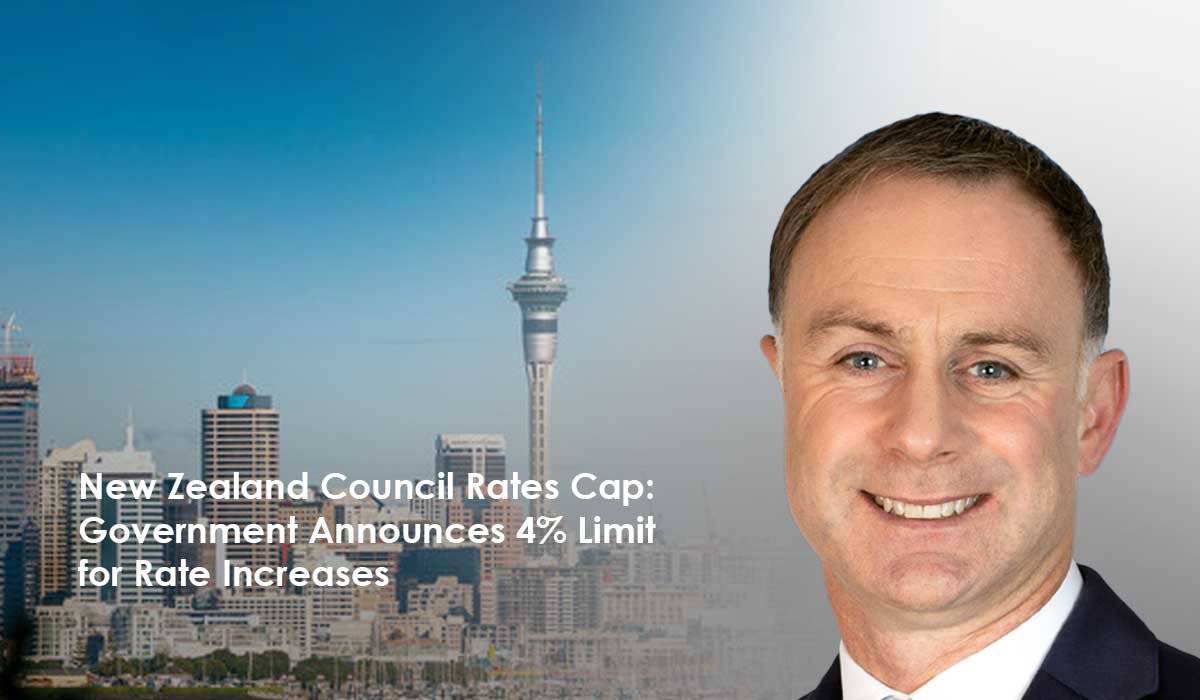
New Zealand homeowners and businesses could have greater certainty over future council rates after the Government announced legislation to introduce a 4 per cent cap on annual council rates increases.
Local Government Minister Simon Watts says the proposed changes are designed to make rates more affordable, ease cost-of-living pressure and encourage councils to focus on essential services.
Under the proposed system, councils will be required to keep annual rates increases within an initial 2 to 4 per cent target range. Councils will begin considering the target range when preparing their long-term plans from 1 July 2027, while the rates caps are scheduled to take full effect from 1 July 2029.
Related Post
The announcement could have a significant impact on households, property owners, landlords and businesses across New Zealand, although the final effect will depend on how the legislation is implemented and how individual councils manage their finances.
Government says rates have become a growing household pressure
The Government says New Zealand ratepayers have experienced significant increases in recent years.
According to the announcement, median rates increases were 14.2 per cent and 9.2 per cent over the past two years respectively.
Minister Simon Watts says the Government wants to reduce the pressure caused by steep and unexpected rates increases and give households greater certainty when planning their finances.
The Government’s argument is that councils should have stronger financial discipline and focus spending on services communities rely on.
These include maintaining local roads, fixing potholes, rubbish collection, parks and swimming pools.
What exactly is the proposed 4% council rates cap?
The proposed system would establish an initial annual rates increase target range of 2 to 4 per cent.
This means the policy is not simply a blanket rule saying every individual property owner’s bill can only increase by 4 per cent.
Council rates can vary between properties depending on factors such as property values, rating structures, targeted rates and other charges.
Instead, the proposed framework would place limits on how much councils can increase rates revenue, subject to the rules and exemptions established under the legislation.
The Government says the target range will be reviewed every six years and can be updated where necessary to account for costs outside councils’ control.
When will the rates cap start?
The changes will be introduced over several years.
Councils will need to consider the 2–4 per cent target range when preparing their long-term plans from 1 July 2027.
However, the Government says the caps will take full effect from 1 July 2029.
This means New Zealanders should not expect an immediate nationwide 4 per cent limit on their next council rates bill.
The transition period is intended to give councils time to prepare for the new framework.
What could the changes mean for homeowners?
For homeowners, greater predictability could make household budgeting easier.
Council rates are one of the ongoing costs associated with owning property, alongside mortgage payments, insurance, maintenance and utilities.
Large annual rates increases can therefore place additional pressure on household finances.
A more predictable rates environment could particularly matter to families managing tight budgets and homeowners who have limited room to absorb unexpected increases.
However, homeowners should also understand that the proposed cap does not necessarily mean every individual rates bill will increase by no more than 4 per cent.
The final amount paid by a property owner will continue to depend on the rating system used by their local council and other applicable charges.
What does it mean for businesses?
Businesses are also likely to watch the policy closely.
Commercial property owners pay council rates, making local government costs part of their ongoing operating expenses.
For small businesses, predictable council costs could make it easier to prepare budgets and forecast expenses.
The Government says the policy is intended to help both households and businesses by making rates more affordable and predictable.
However, the debate is likely to continue over whether councils can maintain infrastructure and services while operating within the proposed limits.
Councils will still have some flexibility
The Government recognises that there could be situations where councils need to raise additional revenue.
The proposed system therefore includes two types of time-bound exemptions.
The first would cover exceptional circumstances where additional rates revenue is needed following events such as natural disasters that are beyond what a council could reasonably be expected to plan for.
The second would be a prudent financial management exemption.
Under this provision, a council could potentially operate above or below the target range if it can demonstrate prudent financial management and a justified need to do so.
Councils seeking this type of exemption would also be required to consult their communities before setting rates.
The Government says exemptions will not be granted lightly.
Water charges are excluded
One important detail for ratepayers is that water services will not be covered by the rates capping system.
The Government says water services will continue to be regulated separately.
This means property owners should not assume that every charge associated with their local council or water services will automatically fall under the proposed 4 per cent limit.
For households, understanding the difference between general council rates and separately regulated water charges will therefore remain important.
Independent regulator to oversee the system
The proposed legislation would also establish an independent regulator to oversee the rates-capping framework.
According to the Government, the regulator would have several responsibilities, including monitoring compliance, assessing exemption applications and advising on future target ranges.
It would also support councils during implementation and transition, provide guidance and report on how the system is operating.
This oversight is intended to ensure councils follow the new framework while allowing limited flexibility where genuine circumstances justify it.
Why infrastructure remains a key issue
One of the biggest questions surrounding the rates cap is how councils will continue funding infrastructure.
Councils are responsible for maintaining and investing in many assets that communities depend on, including local roads, parks, facilities and other infrastructure.
The Government says the target range includes a minimum level of rates increases to help councils continue delivering essential services and investing in infrastructure.
The challenge will be balancing these responsibilities with the Government’s objective of keeping rates increases under control.
If costs rise faster than the permitted rates range, councils may need to find savings, prioritise projects differently or use other financial tools.

What should ratepayers watch next?
The announcement is likely to begin a significant period of discussion around the future of local government finances.
Homeowners, landlords and businesses should watch how the legislation progresses and how individual councils respond.
Key issues to follow include:
- How the proposed legislation is implemented.
- How councils incorporate the target range into long-term plans.
- How exemptions are assessed.
- Whether council spending priorities change.
- How infrastructure projects are funded.
- How separately regulated water costs evolve.
- How the independent regulator operates.
The Government’s stated goal is to provide greater certainty and keep rates increases under control.
For councils, however, the challenge will be ensuring that tighter financial limits do not compromise essential services or long-term infrastructure investment.
What does this mean for New Zealanders?
The proposed council rates cap represents a significant change in the way local government finances could be managed.
For households and businesses, the potential benefit is greater predictability and protection from sharp rates increases.
For councils, the policy could mean greater pressure to prioritise spending, improve efficiency and demonstrate strong financial management.
The full impact will become clearer as the legislation progresses and councils begin preparing for the new system.
For now, the most important dates are 1 July 2027, when councils will need to consider the target range in their long-term planning, and 1 July 2029, when the Government says the caps will take full effect.
Official Source
Source: New Zealand Government, Beehive — Government to cap rates, published 25 August 2026. Read the official Government announcement
Disclaimer
This article is for general news and informational purposes only. The council rates cap is part of a proposed legislative framework and details may change as the legislation progresses. Individual council rates can also vary according to local rating systems, property valuations, targeted rates and separately regulated charges. Readers should check official Government and local council information for the latest details.
FAQs
What is New Zealand's proposed council rates cap?
The Government has proposed an initial 2–4 per cent target range for annual council rates increases, with the caps scheduled to take full effect from 1 July 2029.
Will my council rates bill only increase by 4 per cent?
Not necessarily. The proposed system applies to council rates increases within the framework rather than guaranteeing that every individual property owner's bill will rise by exactly 4 per cent or less. Individual bills can vary depending on local rating structures and other factors.
Are water charges included in the rates cap?
No. Water services are excluded from the proposed rates capping system and will continue to be regulated separately.
When will the rates cap take effect?
Councils will need to consider the target range from 1 July 2027 when preparing long-term plans. The caps are scheduled to take full effect from 1 July 2029.
Can councils increase rates by more than the target range?
Limited, time-bound exemptions are proposed for exceptional circumstances and for councils that can demonstrate prudent financial management and a justified need to operate outside the target range.
For more New Zealand news, updates and community stories, visit NZ Indian Insights