

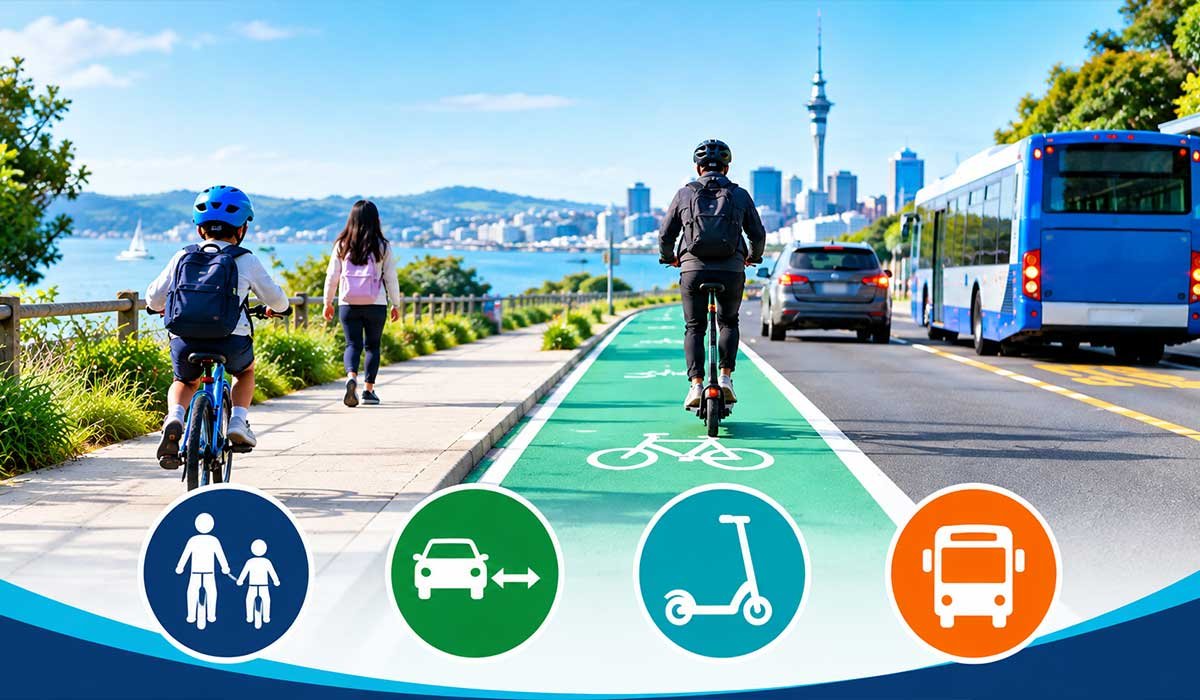
New rules for how people share roads, lanes and footpaths in New Zealand are coming into effect from 1 October 2026.
The changes are designed to make responsibilities clearer for drivers, cyclists, e-scooter users, pedestrians and other road users. According to NZ Transport Agency Waka Kotahi (NZTA), the changes respond to how people are using roads and footpaths today and aim to improve safety.
For people driving to work, taking children to school, cycling around town or using an e-scooter, understanding the updated rules will be important.




Here is a practical look at what is changing.
What are the new lane use rules in New Zealand?
From 1 October 2026, four important changes will affect how some road users share lanes and roads.
The changes include:
- Children aged 12 and under being allowed to ride bicycles on footpaths
- Drivers having to leave at least 1.5 metres when passing certain road users
- E-scooters being allowed to use cycle lanes, subject to the relevant requirements
- Drivers having to give way to buses leaving bus stops on roads with speed limits of 60km/h or less
These changes are being introduced through amendments to New Zealand’s Road User Rule and related regulations.
1. Children aged 12 and under can ride bikes on footpaths
One of the changes that may be particularly relevant to families is the new rule allowing children aged 12 years and under to ride bicycles on footpaths.
Parents or caregivers can also ride with them when supervising and supporting their safety.
For families, this could provide an additional option for children who may not yet feel confident riding alongside traffic on the road.
However, riding on a footpath still requires care and consideration for pedestrians. Families should make sure children understand that footpaths are shared spaces and that other people using them need to be given appropriate consideration.
NZTA says guidance for parents and caregivers will also be made available.
2. Drivers must leave a 1.5 metre gap when passing
Another major change concerns the distance drivers must leave when passing certain road users.
From 1 October, drivers must leave at least 1.5 metres when passing people who are not driving a motor vehicle and are travelling in the same direction in the same lane.
This includes examples such as:
- Cyclists
- Pedestrians
- Horses and riders
The rule is intended to provide more space between motor vehicles and vulnerable road users.
If there is not enough room to safely pass, drivers should slow down and wait until it is safe to do so.
This is particularly important on narrower roads, where attempting to pass without enough space could put another road user at risk.
Drivers should also remember that a vehicle travelling past a cyclist, pedestrian or horse can create wind gusts that may affect the person’s balance or movement.
The key message is simple: if you cannot safely leave the required space, wait.
3. E-scooters can use cycle lanes
The new rules also clarify the use of cycle lanes by e-scooters.
From 1 October, e-scooters that are not considered motor vehicles can ride in cycle lanes.
With e-scooters becoming increasingly visible in New Zealand cities and urban areas, the change provides clearer guidance about where these users can travel.
For drivers, it is another reason to pay attention when approaching or crossing cycle lanes.
For e-scooter users, using a cycle lane does not remove the need to ride responsibly and consider other people using the lane or crossing it.
As always, road signs, lane markings and other traffic controls remain important.
4. Drivers must give way to buses leaving stops on roads up to 60km/h
A further change applies to buses.
On roads where the speed limit is 60km/h or lower, drivers must give way to buses leaving bus stops, the roadside or a bus lane.
There is an important condition: the bus driver must indicate their intention to move for at least three seconds.
This gives nearby drivers time to recognise that the bus is preparing to enter the traffic lane.
For motorists, the practical lesson is to pay attention to buses that are indicating and be prepared to slow down or stop to allow them to move safely into traffic.
The change could be particularly relevant in busy urban areas where buses frequently pull in and out of designated stops.
Why are these changes being introduced?
NZTA says the changes are intended to make lane use safer by making responsibilities clearer for people using bikes, e-scooters, footpaths and roads.
The agency says the changes reflect how people currently use New Zealand’s roads and footpaths and respond to issues raised by road users, councils and advocacy organisations.
NZTA consulted on the proposed changes between 25 February and 25 March 2026 before the changes were progressed.
The changes are being implemented through amendments to the Land Transport (Road User) Rule 2004 and the Land Transport (Offences and Penalties) Regulations 1999.