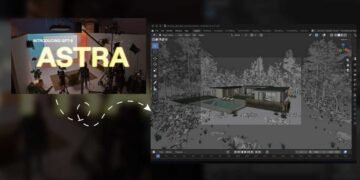

Artificial intelligence continues to evolve at an incredible pace, and OpenAI’s newly announced Astra AI model is already making headlines around the world. Although Astra is not yet available to the public, OpenAI says the model has demonstrated remarkable reasoning abilities by helping solve multiple long-standing mathematical and theoretical computer science problems.
For researchers, businesses, developers, and AI enthusiasts across New Zealand, Astra represents another major step towards AI systems capable of tackling complex scientific challenges rather than simply answering questions.
What Is OpenAI Astra?
Astra is OpenAI’s next-generation research model currently being tested internally. Unlike traditional AI chatbots that focus on conversation, Astra is designed for deep reasoning, scientific research, and solving highly complex problems.
Related Post
According to OpenAI, Astra combines advanced reasoning with formal verification methods, enabling it to generate solutions that can be independently verified by mathematical proof systems.
OPENAI PREVIEWS “ASTRA” IN WASHINGTON D.C.
— Chris (@ChrisGPT) August 1, 2026
According to The Information, OpenAI privately demonstrated a new AI system called Astra to U.S. officials in Washington, D.C.
Now, unfortunately, the article didn’t divulge into whether or not the White House had cleared this for… pic.twitter.com/qT1QV0hIad
Why Is Astra Making Global Headlines?
OpenAI recently announced that an internal version of Astra successfully contributed to solving 10 long-standing open problems in mathematics and theoretical computer science.
Some reported achievements include:
- Improved mathematical proofs
- Advances in coding theory
- Research in quantum complexity
- Progress on high-dimensional geometry
- Machine-verifiable mathematical proofs
The research was later verified using formal proof systems, increasing confidence in the model’s outputs.
How Is Astra Different from Existing AI Models?
Most current AI assistants are excellent at:
- Writing content
- Coding assistance
- Data analysis
- Customer support
- Brainstorming ideas
Astra aims to go much further by helping researchers tackle problems that may take humans months or even years to solve.
Expected capabilities include:
- Advanced scientific reasoning
- Long-horizon planning
- Multi-agent collaboration
- Formal mathematical verification
- Improved research workflows
What Could This Mean for New Zealand?
New Zealand continues to invest in digital innovation, education, healthcare, agriculture, and scientific research.
Future AI systems like Astra could potentially support:
Universities and Researchers
Helping accelerate scientific discoveries and complex data analysis.
Healthcare
Supporting medical research, drug discovery, and evidence analysis.
Agriculture
Improving predictive models for farming and environmental sustainability.
Businesses
Providing smarter automation, research assistance, and decision-making tools.
Education
Creating advanced learning assistants capable of explaining complex subjects with greater accuracy.
Is Astra Available Today?
No.
OpenAI has not announced a public release date for Astra. The model remains part of OpenAI’s internal research efforts, and details regarding availability, pricing, or API access have not yet been confirmed.
The Bigger Picture
Artificial intelligence is rapidly moving beyond simple chatbots.
The next generation of AI focuses on:
- Scientific discovery
- Complex reasoning
- Autonomous research
- Verified knowledge
- Multi-step problem solving
Astra reflects this broader shift toward AI systems designed to assist with some of humanity’s most challenging scientific and engineering problems.
Why This Matters for Businesses
Businesses are increasingly using artificial intelligence to improve productivity, automate repetitive tasks, and make data-driven decisions. As AI technology continues to advance, models like Astra could eventually help organizations solve complex analytical challenges, accelerate research and development, and improve innovation across industries.
While Astra is still under development, its capabilities highlight the growing role AI may play in shaping the future of business, education, and scientific progress.
OpenAI’s Astra AI model demonstrates how quickly artificial intelligence is advancing beyond content generation into the world of scientific research and mathematical reasoning.
Although the technology is still in development, its reported achievements suggest that AI could play an increasingly important role in solving complex global challenges across education, healthcare, science, engineering, and business.
For New Zealand’s growing technology ecosystem, Astra offers a glimpse into the future of intelligent research assistants that could help accelerate innovation in the years ahead.
FAQs
Is OpenAI Astra available to the public?
No. Astra is currently an internal research model and has not been released publicly.
What makes Astra different from ChatGPT?
Astra focuses on advanced reasoning, scientific research, and solving complex mathematical problems rather than general conversation.
Can Astra solve scientific problems?
According to OpenAI, an internal version of Astra contributed to solving 10 long-standing problems in mathematics and theoretical computer science.
Will Astra replace existing AI models?
It is too early to say. Astra appears to complement existing AI systems by specializing in advanced research and reasoning tasks.
Disclaimer: This article is based on publicly available announcements and information shared by OpenAI at the time of writing. Features, capabilities, release timelines, and availability of the Astra AI model may change as development continues.
Read more: Explore the latest AI, technology trends, and innovation updates in our Technology Desk section on NZ Indian Insights.