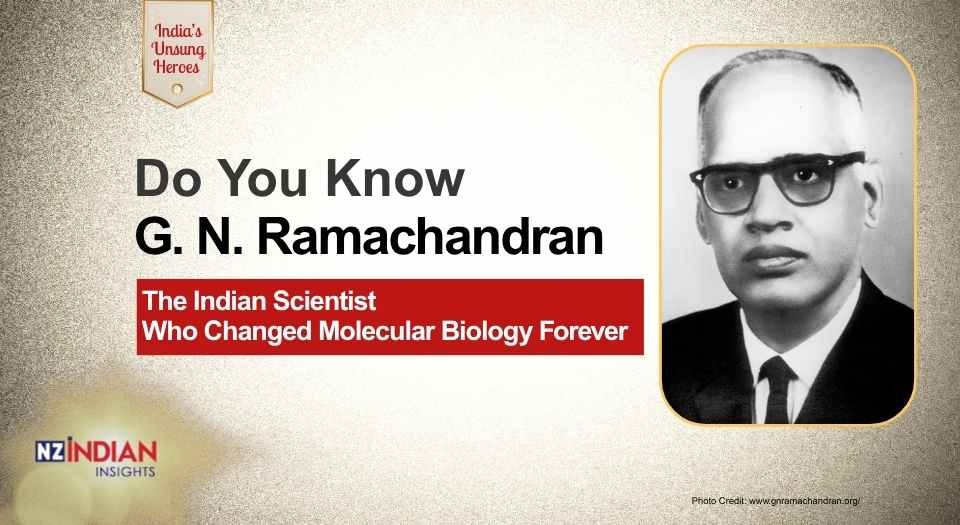
Every great scientific breakthrough begins with someone willing to ask difficult questions. For India, one of those remarkable minds was Dr. Gopalasamudram Narayana Ramachandran, a physicist whose work transformed molecular biology and earned global recognition. Although his name may not be as familiar as Albert Einstein or Marie Curie, his contributions continue to shape modern medicine, biotechnology, and scientific research.
Today, researchers around the world still rely on concepts developed by Dr. Ramachandran decades ago. His work has helped scientists better understand proteins—the building blocks of life—and has influenced everything from disease research to drug development.
As the scientific community continues to celebrate pioneers whose discoveries changed the world, Dr. G. N. Ramachandran’s legacy reminds us that innovation often begins with curiosity, determination, and a passion for solving complex problems.
Early Life and Academic Journey
Born on 8 October 1922 in Kerala, India, G. N. Ramachandran showed exceptional academic ability from a young age. His interest in mathematics and physics eventually led him into scientific research, where he combined theoretical knowledge with practical problem-solving.
He pursued higher education in physics before joining India’s growing scientific community during a period when the country was establishing its place in global research. Working alongside respected scientists, Ramachandran developed a reputation for analytical thinking and innovative ideas.
His academic career later took him to prestigious institutions where he mentored future generations of researchers while continuing groundbreaking investigations into molecular structures.
Understanding the Building Blocks of Life
Proteins perform nearly every essential function inside the human body. They help repair tissues, transport oxygen, fight infections, digest food, and regulate countless biological processes.
During the mid-20th century, scientists understood that proteins were important, but determining their three-dimensional structure remained an enormous challenge.
Dr. Ramachandran believed that understanding protein shapes would unlock answers to many biological mysteries. His research focused on how protein molecules fold into stable structures, laying the foundation for future discoveries in structural biology.
The Revolutionary Ramachandran Plot
Among Dr. Ramachandran’s most celebrated achievements is the development of the Ramachandran Plot, introduced in the early 1960s.
At first glance, it appears to be a simple scientific graph. In reality, it became one of the most valuable tools in molecular biology.
The Ramachandran Plot allows scientists to predict and evaluate the possible angles between atoms within protein molecules. This helps researchers determine whether a proposed protein structure is physically realistic and scientifically accurate.
Even today, students studying biochemistry, biotechnology, and molecular biology learn about the Ramachandran Plot as a fundamental concept. Advanced research laboratories worldwide continue to use it when analysing proteins.
Its lasting relevance highlights the enduring value of Dr. Ramachandran’s work.
Unlocking the Structure of Collagen
Another milestone in Ramachandran’s career was his research into collagen, one of the body’s most abundant proteins.
Collagen provides strength and flexibility to skin, bones, tendons, cartilage, and connective tissues. Understanding its structure has been essential for advances in medicine and tissue engineering.
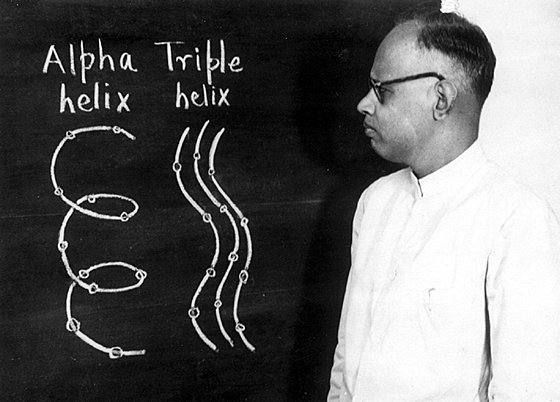
Dr. Ramachandran and his colleagues proposed one of the earliest accurate models explaining collagen’s unique triple-helix structure. Their findings significantly improved scientific understanding of connective tissues and influenced future medical research.
Today, collagen research contributes to studies on wound healing, ageing, orthopaedic treatments, cosmetic science, and regenerative medicine.
A Lasting Influence on Modern Science
Although technology has advanced dramatically since Dr. Ramachandran conducted his pioneering work, many modern scientific methods continue to build upon his discoveries.
His contributions support research in areas such as:
- Drug discovery and pharmaceutical development
- Protein engineering
- Genetic research
- Artificial intelligence in biology
- Vaccine development
- Medical diagnostics
- Biotechnology innovation
Whenever scientists determine the structure of a newly discovered protein, they often rely on principles connected to Ramachandran’s research.
This remarkable continuity demonstrates how one scientist’s ideas can influence generations of researchers.
Inspiring Indian Scientists
Dr. Ramachandran’s achievements hold particular significance for India.
At a time when scientific resources were more limited than today, he produced research that gained worldwide recognition. His accomplishments proved that groundbreaking discoveries could emerge from Indian laboratories and universities.
For young Indian students considering careers in science, engineering, biotechnology, or medicine, his journey remains deeply inspiring.
His life illustrates that international impact is possible through persistence, creativity, and dedication to research.
Why His Legacy Matters Today
The world is entering an era shaped by biotechnology, personalised medicine, artificial intelligence, and advanced healthcare. Understanding proteins has become even more important than it was during Ramachandran’s lifetime.
Researchers investigating diseases such as Alzheimer’s, Parkinson’s, cancer, and rare genetic disorders often study protein structures to understand how these illnesses develop.
The principles established by Dr. Ramachandran continue to support these investigations, making his work relevant more than six decades after its publication.
Scientific breakthroughs rarely happen overnight. They build upon earlier discoveries made by visionary researchers whose contributions continue to guide future innovation.
Recognition Beyond Borders
Throughout his career, Dr. Ramachandran received numerous honours for his scientific achievements. His publications became highly cited, and his work earned respect from researchers across the globe.
Universities continue teaching his methods, while scientific conferences regularly reference his contributions to structural biology.
His name remains synonymous with excellence in molecular research.
Lessons for Future Generations
Dr. G. N. Ramachandran’s story is about more than science. It is about curiosity, resilience, and the willingness to challenge existing ideas.
His achievements remind us that education, critical thinking, and innovation can create lasting global impact regardless of where someone begins their journey.
As India continues investing in research, technology, and higher education, the next generation of scientists can look to pioneers like Ramachandran for inspiration.
Their work demonstrates that meaningful discoveries often emerge from asking bold questions and pursuing knowledge with determination.