
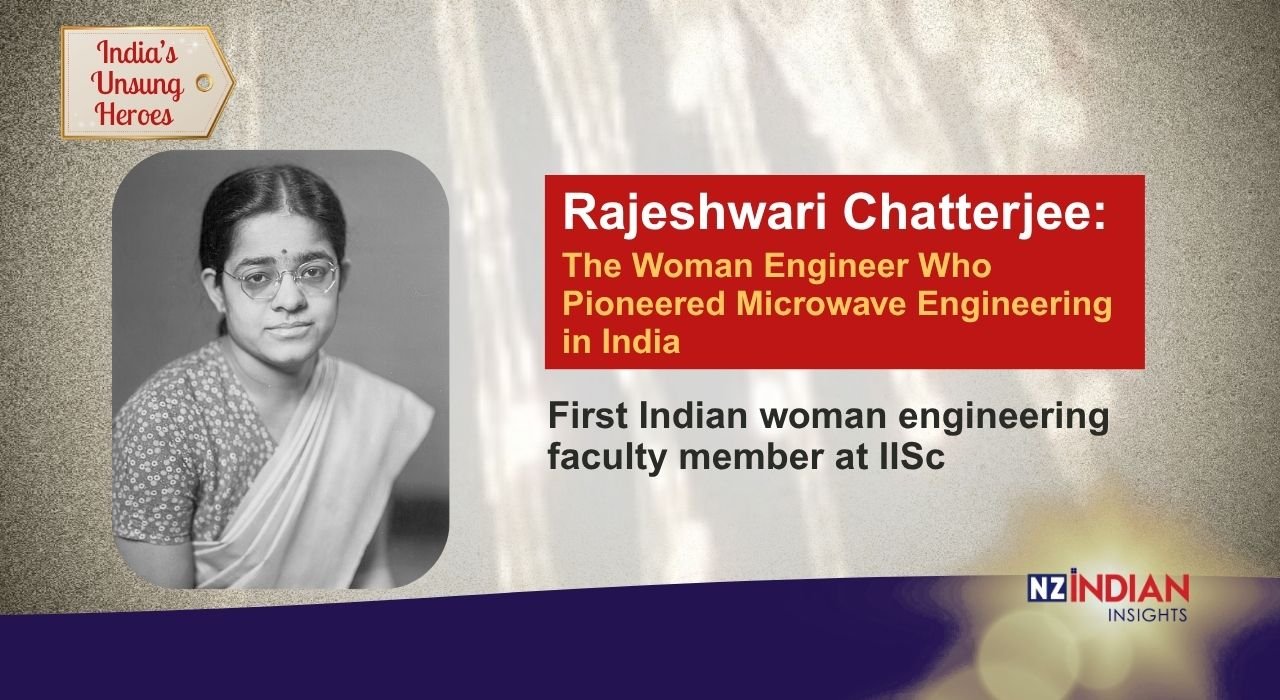
Long before India became a global technology and engineering powerhouse, women who entered advanced scientific fields had to overcome enormous social and professional barriers. Among those trailblazers was Rajeshwari Chatterjee, an Indian scientist, academic and electrical engineer whose pioneering work helped establish microwave engineering and antenna research in India.
Born on 24 January 1922, Chatterjee went on to become the first Indian woman engineering faculty member at the Indian Institute of Science (IISc) and the first woman to chair its Department of Electrical Communication Engineering. Her career helped open doors for women in engineering while contributing to research areas that later became important to radar, communications and defence technology.
Early Life and a Strong Foundation in Education
Rajeshwari Chatterjee grew up in Karnataka in a family that strongly supported women’s education. Her grandmother, Kamalamma Dasappa, was an educationist and social reformer who established a school and worked to expand educational opportunities for women.
Related Post



Chatterjee developed an early interest in mathematics and science. She studied at institutions in Bangalore and completed her B.Sc. (Honours) in Mathematics and later an M.Sc., achieving first rank in her examinations. Her academic performance earned several awards and helped establish her reputation as an exceptionally talented student.
At a time when relatively few Indian women pursued advanced scientific careers, her decision to enter engineering and research was itself groundbreaking.
Her Journey to the Indian Institute of Science
In 1943, Chatterjee joined the Indian Institute of Science as a research student in the Electrical Technology Department. Her early research included electronics and ultra-high-frequency measurements.
Her ambitions eventually took her overseas. Through a government scholarship, she travelled to the United States to study electrical engineering at the University of Michigan.
The journey itself reflected the determination required to pursue higher education during that era. She travelled by sea from Singapore to the United States, a journey that took around 30 days. At Michigan, she completed her master’s studies, undertook practical training in radio-frequency measurements at the National Bureau of Standards in Washington, D.C., and later returned to the University of Michigan for doctoral research.
She earned her Ph.D. in Electrical Engineering in 1953, working under Professor William Gould Dow.
Returning to India to Build a New Field
After completing her doctorate, Chatterjee returned to India and joined the Department of Electrical Communication Engineering at IISc as a faculty member in 1953.
This marked the beginning of one of the most important chapters in her career.
Together with her husband and fellow academic Sisir Kumar Chatterjee, she helped establish India’s first microwave engineering research laboratory. Microwave research was still developing internationally, and India had limited laboratory infrastructure and resources in the field.
Rather than waiting for sophisticated equipment to become available, the researchers built much of what they needed themselves. IISc records describe how the laboratory was developed from the ground up, including instruments and components made using indigenous resources.
Why Microwave Engineering Mattered
Microwave engineering focuses on the generation, transmission and use of electromagnetic waves at microwave frequencies.
Today, microwave technology is associated with many areas of modern technology, including:
- Radar systems
- Wireless communication
- Satellite communication
- Antenna systems
- Defence technology
- Navigation and sensing
- Radio-frequency systems
In Chatterjee’s era, these technologies were still developing rapidly. Her research and teaching helped create an academic foundation for microwave engineering in India.
She and her colleagues also introduced courses in microwave technology and satellite communication during the 1960s, helping train a generation of Indian engineers and researchers in emerging technologies.
Research That Reached Beyond the Classroom
Chatterjee’s contribution was not limited to teaching.
Over a career spanning roughly three decades, she carried out research in microwave engineering, antenna technology, electromagnetic theory and communication systems. IISc records note that she published more than 100 research papers and supervised around 20 Ph.D. students.
Her work also included research connected with defence applications. IISc has noted that her microwave research contributed to technologies associated with radar and defence applications, including work that later had relevance to DRDO programmes.
Her own account of her career records research projects involving Defence R&D and specialised microwave devices, demonstrating the breadth of her scientific work.
A Teacher, Author and Mentor
Rajeshwari Chatterjee was also an influential educator.
She taught subjects including electromagnetic theory, electron tube circuits, microwave technology and radio engineering. Her influence extended through the students she supervised, many of whom went on to build careers in engineering, research and strategic technology programmes.
She also authored technical books on microwave engineering and antennas. IISc’s own account records four books on microwave engineering and three on antennas, while noting that she had around 120 research publications.
Her work therefore created impact at several levels: research, education, textbooks and mentorship.
Breaking Barriers in Engineering
Chatterjee’s achievements become even more significant when viewed against the period in which she worked.
Engineering departments in India were overwhelmingly male-dominated. Chatterjee became the first Indian woman faculty member at IISc and later became the first woman to chair a department there. She led the Department of Electrical Communication Engineering from 1979 to 1981.
Her position was not simply a personal achievement. It demonstrated that women could lead advanced engineering research and academic institutions at a time when such opportunities were rare.
She also remained interested in issues affecting women and continued social work after retiring from IISc.
Recognition for Her Scientific Contributions
Chatterjee received several honours during her career, including the Meghnad Saha Award, J.C. Bose Memorial Prize and Ram Lal Wadhwa Gold Medal for her work in electronics, engineering research and teaching.
The University of Michigan has also recognised her as the first woman scientist to pioneer microwave engineering in India.
A Legacy That Continues
Rajeshwari Chatterjee died on 3 September 2010, but her contribution to Indian science continues to be remembered.
Her legacy is not only found in research papers, laboratories or technical books. It can also be seen in the generations of engineers and scientists who followed paths that were made easier because pioneers like her had gone first.
She entered engineering when opportunities for women were limited, travelled overseas for advanced education when such journeys were uncommon, returned to India and helped build a new research field almost from scratch.
That combination of scientific curiosity, academic excellence, persistence and leadership makes her story especially relevant today.
Why Rajeshwari Chatterjee Still Matters
Modern India is home to women leading research in artificial intelligence, space technology, electronics, telecommunications, biotechnology and advanced engineering. Their achievements stand on a much longer history of women challenging the boundaries of what was considered possible.
Rajeshwari Chatterjee was one of those early pioneers.
Her journey shows that technological progress is not only about inventions and machines. It is also about the people willing to enter unexplored fields, build institutions, mentor others and create opportunities for those who come next.
As India’s first woman engineering faculty member at IISc and a pioneer of microwave engineering, Chatterjee helped establish an important chapter in the country’s scientific history.
Her story remains a powerful reminder that breaking one barrier can make it possible for an entire generation to go further.