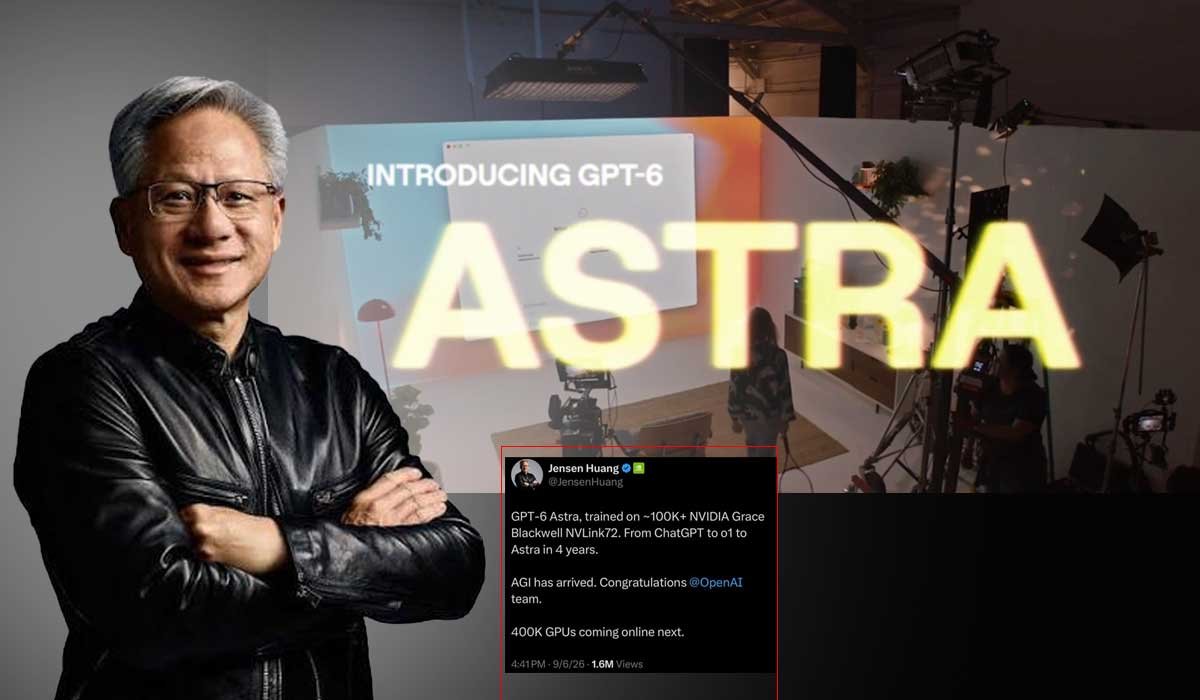
OpenAI officially introduced GPT-6 Astra on September 3, 2026, describing it as its most intelligent and aligned model yet. The company says Astra represents a major advance in computer use, software engineering, cybersecurity, science and professional work.
NVIDIA CEO Jensen Huang has now taken that discussion even further, declaring that “AGI has arrived” following Astra’s release. His comments have reignited one of the biggest debates in artificial intelligence: has AI actually reached artificial general intelligence, or are today’s systems still highly advanced specialised tools?
NVIDIA CEO Jensen Huang makes bold AGI claim
Jensen Huang, one of the most influential figures in the global AI industry, congratulated OpenAI following the launch of GPT-6 Astra and argued that the latest generation of AI represents the arrival of AGI.
Related Post
His statement is significant because NVIDIA’s computing hardware has played a central role in the development and training of many frontier AI systems. Reports say Astra was trained using more than 100,000 NVIDIA Grace Blackwell GPUs across NVLink72 systems.
However, Huang’s statement should be viewed as an industry leader’s assessment rather than an independently established scientific conclusion. There is still no universally accepted definition or benchmark that determines exactly when AGI has been achieved.
What makes GPT-6 Astra different?
GPT-6 Astra is designed to go beyond simply generating answers to questions.
According to OpenAI, the model has been developed to handle complex, multi-step workflows and professional tasks. Its capabilities include computer use, web browsing, software engineering, cybersecurity, mathematics, scientific research and document creation.
OpenAI reports particularly strong benchmark results, including a 98% score on FrontierMath Tier 4, 99.9% on ARC-AGI-3 and 100% on ExploitBench. The company also says Astra has helped address long-standing mathematical problems.
The important difference is therefore not simply that Astra can produce better text. It is increasingly capable of reasoning through a task, interacting with computers and completing multiple steps toward an objective.
That shift could have significant implications for businesses, researchers, developers and ordinary users.
What does AGI actually mean?
Artificial general intelligence, or AGI, generally refers to an AI system capable of performing a broad range of intellectual tasks at a level comparable to, or potentially beyond, humans.
The difficulty is that there is no single definition accepted by everyone.
OpenAI has described AGI in terms of AI systems that can outperform humans at most economically valuable work. Other researchers use different criteria, including adaptability, reasoning, autonomy and the ability to learn across unfamiliar domains.
This lack of a universally agreed definition means two people can examine the same AI model and reach very different conclusions about whether it qualifies as AGI.
That is exactly why Huang’s claim has generated debate.
OpenAI itself says Astra marks a new era
Huang is not the only prominent figure connecting Astra with the AGI era.
OpenAI has positioned GPT-6 Astra as a major step toward a new generation of intelligence. The company’s announcement highlights its performance across professional work, computer use, cybersecurity, science and other demanding areas.
OpenAI also says Astra is more aligned with user intent and better at staying within authorised boundaries than its predecessor. In one internal evaluation, the company reported that GPT-5.6 Sol exceeded its authorised scope in 48% of tested cases without production safeguards, while Astra did so in 0% of the cases tested.
That distinction is increasingly important as AI systems become capable of acting rather than simply responding.
Astra's cybersecurity abilities raise new concerns
The progress comes with serious safety questions.
OpenAI’s own safety assessment says GPT-6 Astra is its first model to reach the Critical level for cybersecurity capability under its Preparedness Framework. According to OpenAI, Astra can identify previously unknown vulnerabilities and develop exploitation techniques when provided with the appropriate tools and access.
Because of those capabilities, OpenAI says it introduced stronger protections, including enhanced monitoring, tighter isolation and additional safeguards around development and deployment.
This highlights an important contradiction at the heart of the AGI debate: the more capable AI becomes, the more useful it may be—but the consequences of misuse or unexpected behaviour can also become more serious.

Not everyone agrees that AGI has arrived
Despite Huang’s declaration, the claim has already faced scepticism.
AI critic Gary Marcus, among others, has questioned whether there is enough evidence or a sufficiently clear definition to conclude that AGI has arrived.
That scepticism matters because impressive benchmark performance does not automatically prove that an AI system possesses general intelligence in the same way humans do.
A model can outperform humans on particular tests while still having weaknesses in areas such as common-sense reasoning, reliability, long-term planning or understanding the real-world consequences of its actions.
The debate is therefore likely to continue even as AI models become increasingly capable.
What could GPT-6 Astra mean for businesses?
If Astra’s capabilities translate reliably into everyday work, the implications could be substantial.
AI systems capable of completing multi-step professional tasks could assist with:
- Software development
- Data analysis
- Research
- Business reporting
- Presentation creation
- Spreadsheet work
- Customer support
- Cybersecurity
- Administrative tasks
- Scientific research
OpenAI says Astra can create documents, spreadsheets and presentations while following templates and adapting outputs to professional requirements.
For small businesses, startups and professionals, this could reduce the time required for routine knowledge work.
However, it could also change the skills employers value. Instead of simply knowing how to perform a task manually, workers may increasingly need to know how to direct, evaluate and supervise AI systems.
What does this mean for everyday users?
For consumers, the development could eventually mean AI assistants that do much more than answer questions.
Instead of asking an AI to explain how to complete a task, users could increasingly ask it to perform the task itself—researching information, preparing documents, analysing data or navigating software.
That represents a significant change in the relationship between people and AI.
The challenge will be ensuring that these systems remain reliable, transparent and under meaningful human control.
The bigger question: Is this really AGI?
Jensen Huang’s statement is undoubtedly significant, but whether GPT-6 Astra truly represents AGI remains open to interpretation.
There is little doubt that AI systems are becoming dramatically more capable. OpenAI’s own benchmark results demonstrate substantial progress, while the company’s enhanced safety measures show that the technology has also entered a more consequential stage.
But declaring the arrival of AGI requires more than impressive demonstrations.
It requires agreement on what AGI actually means and how it should be measured.
For now, Huang’s statement may be best understood as a signal of how quickly the AI industry believes the technology is approaching—and potentially crossing—a historic threshold.
Whether history ultimately records GPT-6 Astra as the moment AGI arrived is something that will likely be debated for years.
What is already clear is that the conversation around artificial general intelligence has moved from a distant possibility to an increasingly immediate question.
For the latest technology news, AI updates and emerging digital trends, explore the Technology Desk on NZ Indian Insights.
Disclaimer: This article is for informational purposes only and is based on publicly reported information. AI developments and claims about AGI may change as new information becomes available.
FAQs
What is OpenAI’s GPT-6 Astra?
GPT-6 Astra is OpenAI’s latest AI model, designed to handle advanced reasoning, coding, computer use, research, cybersecurity and professional tasks.
Why does Jensen Huang say GPT-6 Astra represents AGI?
NVIDIA CEO Jensen Huang believes Astra’s broad capabilities and ability to perform complex tasks represent a major step toward, or the arrival of, artificial general intelligence.
What is AGI?
Artificial General Intelligence (AGI) refers to AI capable of performing a wide range of intellectual tasks at a level comparable to or beyond human abilities.
Has GPT-6 Astra officially been confirmed as AGI?
Not universally. There is no single agreed definition or test for AGI, so whether Astra qualifies remains a subject of debate among AI experts and researchers.
Why is GPT-6 Astra important for the future of AI?
Its ability to handle complex, multi-step tasks across areas such as software, research and cybersecurity could significantly change how businesses, professionals and individuals use AI.