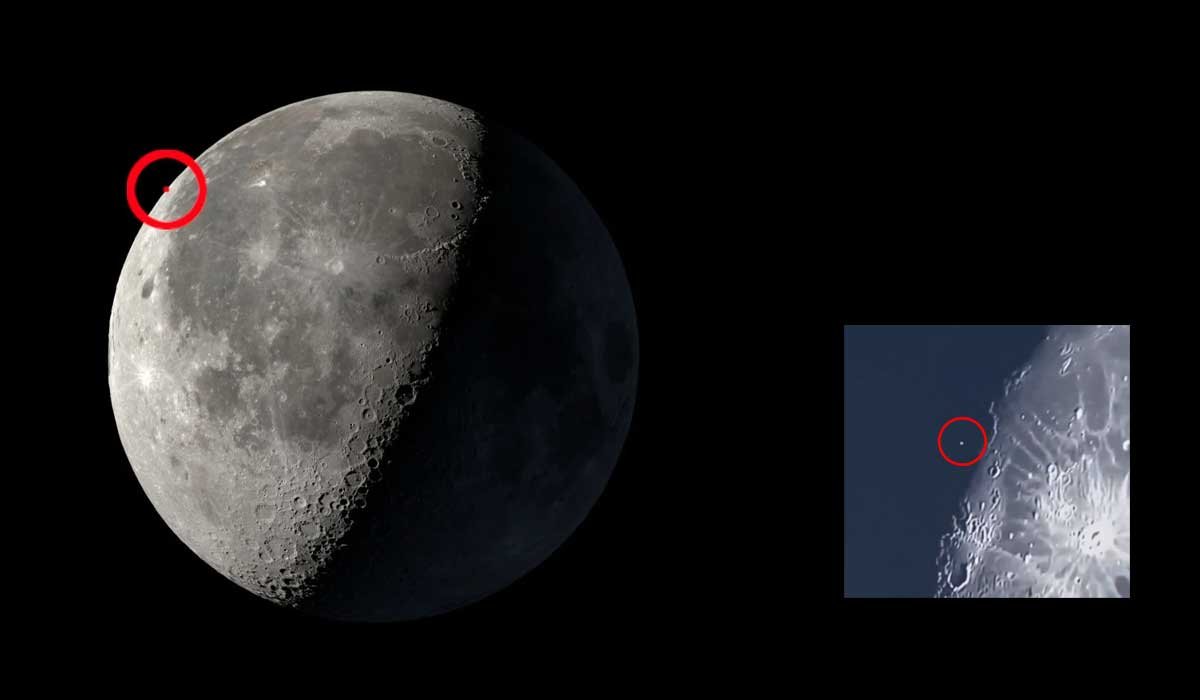
Scientists say the high-speed collision offers valuable insights into lunar geology and the growing challenge of space debris.
A Rare Human-Made Impact on the Moon
A discarded SpaceX Falcon 9 rocket stage has made headlines after colliding with the Moon in a rare human-made lunar impact. Travelling at an estimated 8,700 kilometres per hour, the rocket debris struck the Moon’s surface, creating a new crater and giving scientists an unusual opportunity to study how high-speed impacts shape the lunar landscape.
Although the event may sound dramatic, experts have confirmed that it poses no threat to Earth. Instead, it serves as an important reminder of the increasing number of human-made objects travelling through space as lunar exploration continues to expand.
What Happened?
The object involved was the upper stage of a SpaceX Falcon 9 rocket that had completed its mission months earlier. After delivering its payload, the rocket stage remained in space rather than returning to Earth.
Over time, gravitational forces from the Earth, Moon and Sun gradually altered its orbit. Scientists tracking the object predicted that it would eventually collide with the Moon, and the impact occurred as expected.
Unlike spacecraft designed to land safely, the rocket stage crashed directly into the lunar surface at tremendous speed.
Travelling at 8,700 km/h
The discarded rocket stage impacted the Moon at approximately 8,700 km/h (5,400 mph).
At that velocity, the collision released a significant amount of energy, enough to excavate a fresh crater in the Moon’s dusty surface. While much smaller than craters formed by asteroids, the impact still provides valuable scientific data because researchers know the object’s size, weight and approximate speed.
This makes it easier to compare real observations with computer models of lunar impacts.
Why Scientists Are Excited
Every new impact on the Moon helps researchers better understand how its surface changes over time.
Because the Moon has no atmosphere, wind or rain, impact craters remain visible for extremely long periods. Scientists hope orbiting spacecraft will soon photograph the new crater, allowing them to analyse:
- The crater’s size and depth
- How lunar dust spread after the collision
- The amount of material thrown from the impact site
- Whether computer models accurately predicted the result
These observations could improve future research into lunar geology and planetary science.
A Growing Space Debris Challenge
The incident also highlights an important issue facing the global space community.
As more countries and private companies launch missions beyond Earth, increasing numbers of rocket stages and spacecraft components remain in deep space after completing their missions.
While many spacecraft are designed to burn up safely in Earth’s atmosphere, missions travelling toward the Moon or deeper into space cannot always do so.
Scientists say better planning for spacecraft disposal will become increasingly important as lunar missions become more frequent in the coming years.
Does This Affect Future Moon Missions?
Not directly.
The Moon is enormous, and the impact occurred far from planned landing sites. However, future lunar missions may use information from this event to better understand how impacts affect the surface and how equipment could be protected from similar collisions.
With NASA’s Artemis programme and several commercial lunar missions planned over the next decade, understanding the Moon’s environment is becoming increasingly important.
No Danger to Earth
Despite the dramatic headlines, there is no reason for public concern.
The rocket stage had been travelling through space long after completing its mission, and scientists had accurately predicted the collision well before it happened.
The impact occurred millions of kilometres away and poses no risk to people, satellites or Earth’s environment.
What Happens Next?
Scientists are now waiting for lunar orbiters to capture images of the impact site. These photographs will help confirm the crater’s exact location and size.
Researchers expect the findings to improve future models of lunar impacts and provide valuable data for upcoming Moon missions.
As humanity prepares for a new era of lunar exploration, even accidental events like this can contribute to scientific knowledge and improve future space operations.