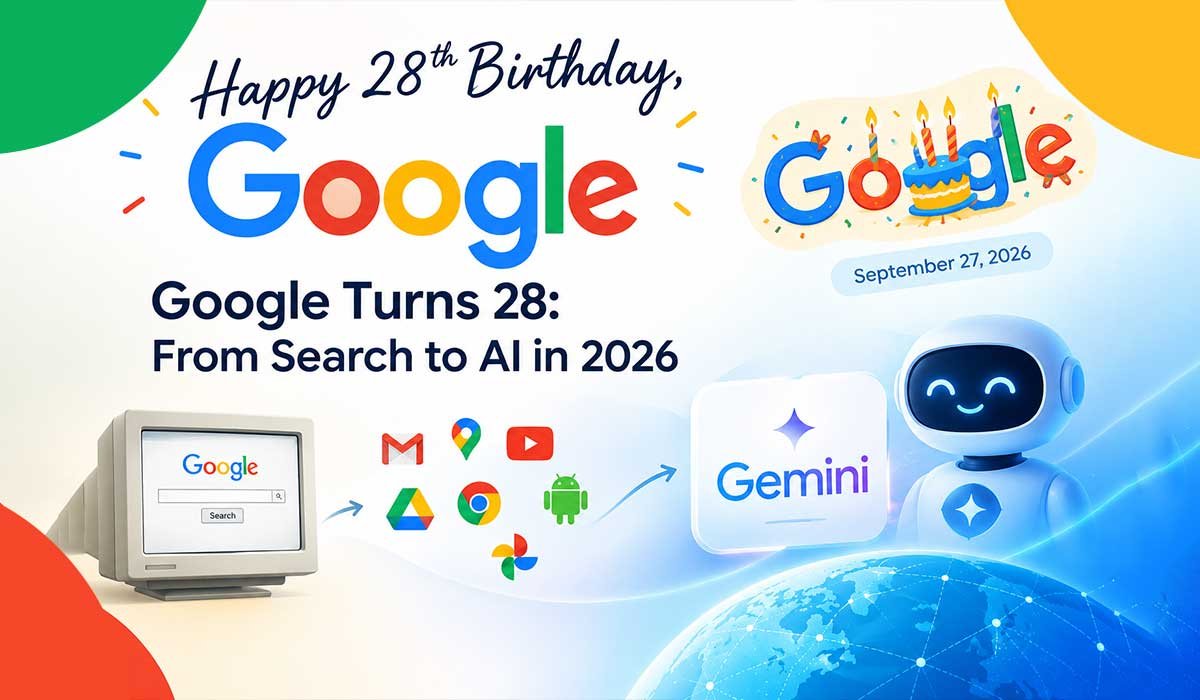
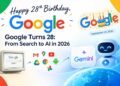
Google is celebrating its 28th birthday on September 27, 2026, with a nostalgic Google Doodle that looks back at the company’s early days. But behind the familiar logo is a much bigger story — one that stretches from a university research project and internet search to artificial intelligence, Gemini and the next generation of technology.
For millions of people in India, New Zealand and around the world, Google has become part of everyday digital life. From searching for information and checking directions to watching YouTube videos, using Gmail, finding businesses and increasingly asking AI-powered questions, Google has changed how people interact with information.
The 2026 birthday celebration offers a chance to look back at that journey — and at how dramatically Google’s role in technology has changed.
Related Post
Google Turns 28 in 2026
Google is marking its 28th birthday on September 27, 2026, with a special Google Doodle.
The Doodle brings a nostalgic feel to Google’s homepage, reflecting on the company’s early identity and its journey over nearly three decades. Google’s official Doodles website lists Google’s Birthday 2026 among its latest Doodles for September 27.
But there is an interesting detail behind the date.
Google was officially incorporated on September 4, 1998, while September 27 became the company’s traditional birthday celebration date. Google has also used different September dates for birthday celebrations in its earlier years before settling on September 27.
So, Google’s birthday is not simply about the date the company was legally incorporated. It has become a long-running tradition associated with the company’s early history and its evolution.
It All Started With Search
The story of Google began in the mid-1990s, when Larry Page and Sergey Brin were students at Stanford University.
Their early work focused on improving how information on the rapidly growing World Wide Web could be organised and found.
The project was initially known as BackRub. Instead of simply looking at words appearing on webpages, the system examined relationships between webpages and links to help determine which information could be more useful.
That idea eventually became Google.
The company was incorporated in 1998, transforming an academic research project into a business that would go on to influence the way billions of people access information.
What looked like a relatively simple question – How can people find useful information on the internet? — became the foundation of one of the world’s most recognisable technology companies.
Why Google Became Part of Everyday Life
Google’s growth was not only about having a search box.
Over the years, Google expanded into a much larger ecosystem of digital products and services.
Search became connected with products such as:
- Gmail
- Google Maps
- Google Photos
- YouTube
- Android
- Google Drive
- Google Chrome
- Google Play
- Google Cloud
This expansion changed Google from being primarily associated with internet search into a company involved in communication, mobile technology, productivity, entertainment, advertising, cloud computing and more.
Google itself has previously described its long-term journey as being driven by people’s curiosity and the questions they ask. In its 25th birthday reflection, the company highlighted how user questions and changing information needs helped drive the development of products such as Google Images.
From Search to AI
Perhaps the biggest change in Google’s story today is artificial intelligence.
For many years, the basic Google experience was familiar: type a question, receive a list of webpages and choose the information you wanted.
AI is changing that model.
Instead of only helping users find information, modern AI systems can increasingly understand questions in context, work with different types of information, generate content, assist with tasks and provide more conversational interactions.
Google has been investing heavily in AI and has brought these capabilities into its wider technology ecosystem.
One of the most visible examples is Gemini, Google’s AI platform.
This represents an important shift in the way Google approaches information. Search remains central to Google’s identity, but AI is increasingly becoming another way users interact with information and technology.
Google's Doodle Story Also Has a Connection to Innovation
Google Doodles themselves have an interesting history.
According to Google’s official Doodles history, the first Doodle appeared in 1998, when Larry Page and Sergey Brin modified the Google logo as an informal “out of office” message while attending the Burning Man festival.
What started as a simple logo change eventually became a global creative tradition.
Today, Doodles can celebrate:
- Important anniversaries
- Festivals and holidays
- Artists and cultural figures
- Scientific achievements
- Sporting events
- Historical moments
- Interactive experiences
Google says Doodles can take the form of illustrations, animations, videos, slideshows and interactive games.
That makes the birthday Doodle more than just a decoration on the homepage. It is part of a tradition that has accompanied Google’s development for decades.
From a University Project to an AI Future
Google’s journey is striking because the technology landscape around it has changed so dramatically.
In the late 1990s, the internet itself was still developing. Finding information online was a very different experience from what people know today.
Then came the rapid expansion of broadband, smartphones, social media, cloud computing and mobile apps.
Now another major shift is underway: AI is becoming an increasingly important part of everyday technology.
Google’s own birthday celebrations have reflected this evolution. For its 25th birthday in 2023, Google looked back at the evolution of its logo and Search while also highlighting the potential of AI to influence the company’s next chapter.
Three years later, the conversation around Google and AI has become even more significant.
What Google's AI Shift Could Mean for Everyday Users
For everyday users, the move towards AI could change how they search, work and create.
Students may use AI tools to understand complicated subjects or organise ideas.
Businesses can use AI to analyse information, create content, support customers and improve productivity.
Developers can use AI-assisted tools to write and understand code.
Creators can experiment with AI-generated images, text, video and other forms of content.
Families may use AI-powered tools for planning, learning and everyday tasks.
For Indian and Kiwi-Indian communities, these technologies can also make it easier to work across countries and cultures from researching information in different languages to communicating with family members overseas and managing international work or study.
At the same time, AI brings new questions around accuracy, privacy, copyright, misinformation and responsible use.
The technology may be moving quickly, but the need to check important information remains.
Google's Birthday Is Also a Reminder of How Fast Technology Moves
Perhaps the most interesting part of Google’s 28th birthday is not simply that Google is 28 years old.
It is how different the technology landscape is compared with 1998.
A company that began by helping people search the growing World Wide Web now operates across search, mobile devices, cloud computing, video, productivity tools and artificial intelligence.
The familiar Google search box remains, but the way people interact with technology is changing.
The next chapter may be less about simply searching for information and more about working with information through AI.
From “Google It” to “Ask AI”
For an entire generation, the phrase “Google it” became almost synonymous with looking something up online.
Now, another behaviour is emerging: asking an AI assistant to explain, summarise, compare, create or help complete a task.
That does not necessarily mean traditional search disappears.
Instead, the two experiences may increasingly work together.
Search can help people discover sources and current information, while AI can help them understand and work with that information.
The balance between the two will continue to evolve as technology develops.
A Birthday Worth Looking Back On
Google’s 2026 birthday is therefore more than a celebration of another year.
It is a reminder of a technology journey that began with two students, an ambitious idea and a rapidly growing internet.
From BackRub to Google Search, from Gmail and Android to Gemini and AI, the company has continued to expand its role in the digital world.
The Google Doodle for September 27, 2026, gives users a nostalgic look at where the journey began.
But perhaps the more interesting question is where it goes next.
After 28 years, Google’s story is still being written and increasingly, artificial intelligence is becoming an important part of that next chapter.
Happy 28th Birthday, Google.

For more technology and digital updates, explore the Technology Desk on NZ Indian Insights.
Disclaimer: This article is for general informational purposes and is based on publicly available information from Google and other referenced sources. Details may change as Google’s products and AI technology continue to evolve.
FAQs
When is Google's birthday in 2026?
Google is celebrating its birthday on September 27, 2026. The company was officially incorporated on September 4, 1998, but September 27 has become its traditional birthday celebration date.
How old is Google in 2026?
Google is celebrating its 28th birthday in 2026.
Who founded Google?
Google was founded by Larry Page and Sergey Brin, who began developing the search engine while they were students at Stanford University.
What was Google called before Google?
The early search project developed by Larry Page and Sergey Brin was known as BackRub before the Google name was adopted.
What is Google's connection with AI?
Google has increasingly integrated artificial intelligence into its products and services, with Gemini representing a major part of its current AI strategy.