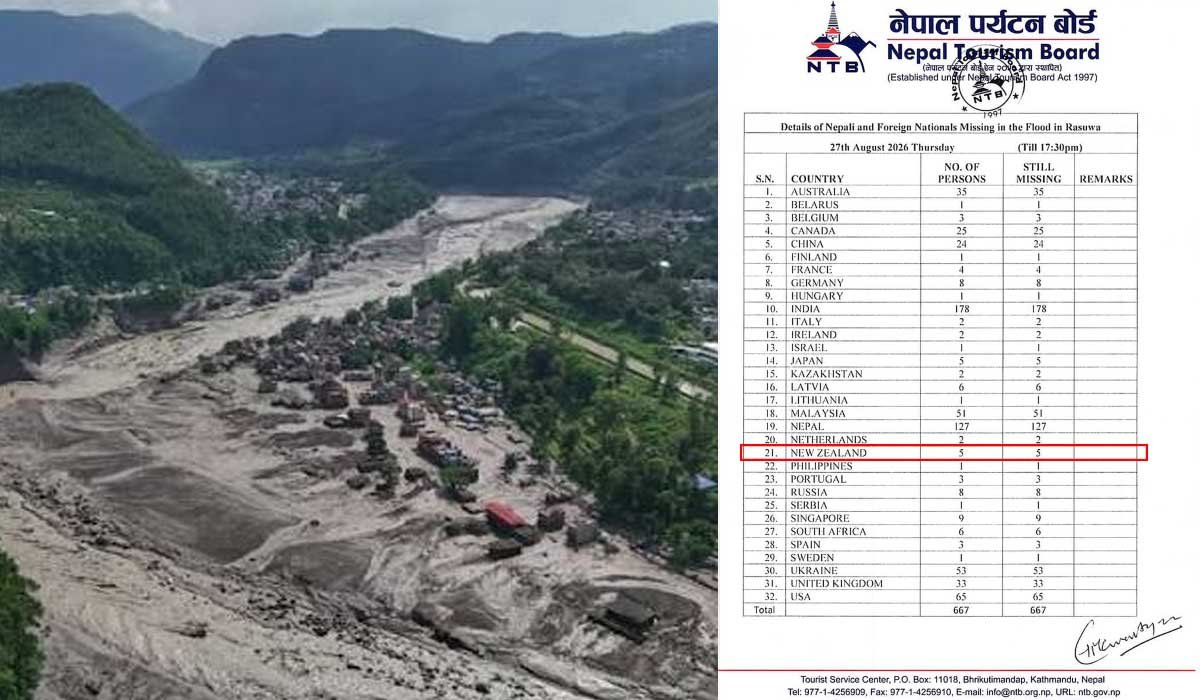
The search for thousands of people missing after devastating flash floods and landslides across the Nepal–Tibet border region is continuing, with five New Zealanders among those still unaccounted for.
The disaster has left a trail of destruction across remote Himalayan communities, with homes, roads, bridges and other infrastructure swept away by powerful floodwaters. Rescue teams are continuing to search difficult terrain while families wait anxiously for information about missing relatives.
Latest international reports indicate that the combined number of people missing in Nepal and Tibet has approached 3,000. The confirmed death toll has also risen sharply, with hundreds of people reported dead across the affected areas. Because rescue teams are still reaching isolated locations and authorities are reconciling different lists, casualty and missing-person figures continue to change.
Related Post

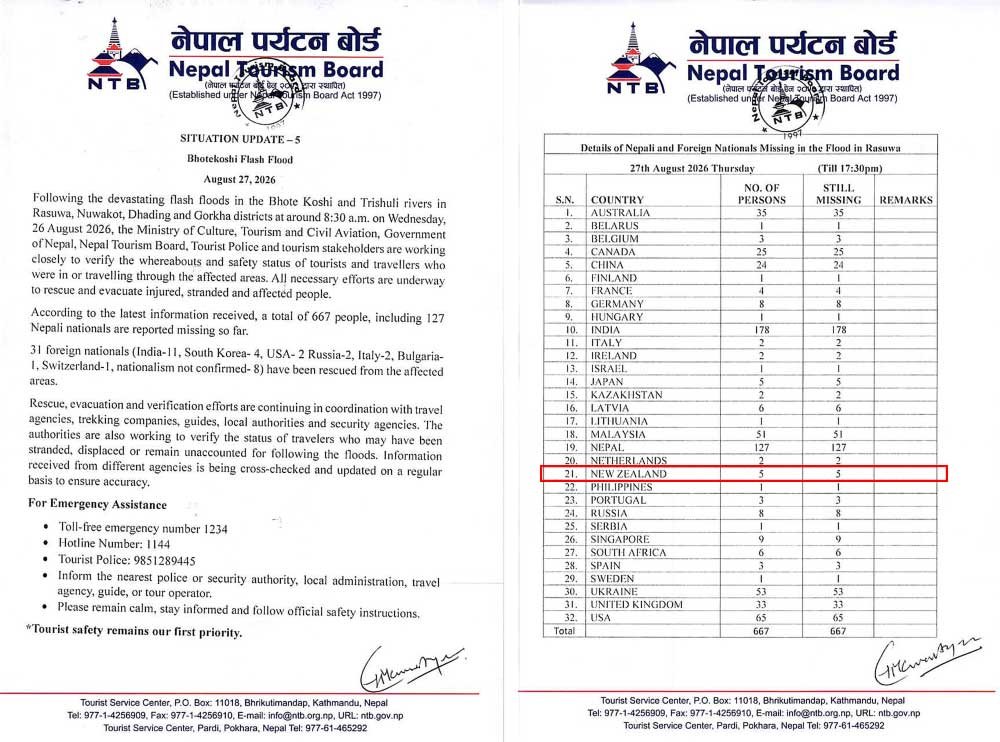
Five New Zealanders remain unaccounted for
The five New Zealanders are among foreign nationals reported missing following the disaster.
The Nepal Tourism Board has listed five New Zealand citizens among people who remain unaccounted for. Reports from New Zealand media say the missing people include Mihir Patel, Kinnari Patel, Shweta Mhatre, Dejan Kuzmic and Suhasini Reddy.
Their disappearance has prompted concern among families, friends and communities in New Zealand.
Auckland’s Nepali community gathered for a candlelight vigil on Saturday, with political representatives and community leaders joining those expressing solidarity with people affected by the disaster.
The gathering also highlighted the uncertainty facing families who have not yet received confirmation about their loved ones.
Nepal Tourism Board website: https://ntb.gov.np
A disaster spanning Nepal and Tibet
The floods struck mountainous areas close to the Nepal–China border after a sudden and extremely destructive event in the Himalayan region.
Early reports pointed to several possible triggers, but subsequent assessments have increasingly focused on a glacier-related event. Reuters reported that the disaster was caused by the collapse of a glacier and underlying rock, sending an enormous surge of water, ice and debris through mountain river systems.
The force of the flood was particularly devastating along river corridors where communities, hydropower projects, roads and tourist routes are located.
Remote geography has made the emergency response considerably more difficult. Some affected locations can only be reached by helicopter, while damaged roads and bridges have restricted access for rescuers and aid workers.
Thousands remain missing
The scale of the missing-person crisis has changed rapidly as authorities have updated their figures.
An Associated Press report said Nepal had recorded 2,498 missing people, while China reported 546 missing people on its side of the disaster zone. Together, the figures put the number above 3,000, although the totals remain subject to verification.
Other reports have placed the combined figure at close to 3,000, while individual Nepalese updates have produced lower totals depending on which categories of missing people are included.
The differences partly reflect the chaotic circumstances following the floods. People may be reported missing by families before authorities can establish their location, while foreign tourists, workers, pilgrims and local residents may appear on separate lists.
Authorities have also warned that figures can change as survivors are located and identities are confirmed.
Foreign nationals caught in the disaster
The floods have affected people from numerous countries, including tourists, pilgrims and foreign workers.
Nepal Tourism Board figures reported hundreds of foreign nationals among those unaccounted for. Earlier updates listed missing citizens from countries including India, the United States, Ukraine, Malaysia, Australia, Britain and Canada, alongside smaller numbers from New Zealand and several European and Asian countries.
India has been particularly affected, with a significant number of Indian nationals reported missing or stranded in the wider disaster area.
The situation has also affected people working on hydropower projects. Hundreds of workers were reported missing from facilities along the affected river corridors, adding another difficult dimension to the rescue operation.
Rescue operations continue despite difficult conditions
Nepalese authorities have resumed search-and-rescue operations after weather and dangerous conditions temporarily disrupted some efforts.
Helicopters have been used to evacuate survivors from isolated areas, while rescue teams have searched damaged buildings, tunnels and other locations where people may still be trapped.
One of the major challenges has been reaching hydropower facilities and communities cut off by landslides and destroyed roads.
International assistance is also being provided. India and China have deployed teams and resources, while other countries are assisting their citizens and providing humanitarian support. Nepal has also sought international technical assistance for specialised rescue and recovery work.
Families continue to wait for answers
For families of the missing, the continuing uncertainty is becoming one of the most painful aspects of the disaster.
Hospitals and relief centres have become places where relatives search for information, while authorities work to identify recovered bodies and match them with missing-person reports.
In some cases, identification has been complicated by the condition of recovered remains. Nepalese authorities have been collecting DNA samples to help establish identities and provide answers to families.
For the families of the five New Zealanders, there is also a long wait for official confirmation.
New Zealand officials and community representatives have been monitoring the situation and supporting affected families. At the Auckland vigil, members of the Nepali community stressed the importance of standing together while the search continues.
A long road to recovery
Beyond the immediate search for survivors, Nepal faces a major reconstruction challenge.
The floods have damaged critical infrastructure and disrupted transport and tourism in areas that depend heavily on visitors and trekking activity.
Nepal’s Finance Minister has estimated that rebuilding could cost between US$4 billion and US$5 billion, according to Reuters.
The economic consequences are expected to extend well beyond the immediate emergency, particularly for communities dependent on tourism, transportation, construction and hydropower.
For now, however, the priority remains finding those who are still missing.
As rescue crews continue to work through devastated valleys and river corridors, families in Nepal, New Zealand and many other countries are holding on to hope that more survivors will be found.
Disclaimer: This article has been independently rewritten for editorial purposes using publicly available media reports and agency information. Figures relating to deaths and missing people are developing and may change as authorities continue verification, rescue operations and identification efforts.