India’s Unsung Heroes: Sir M. Visvesvaraya and the Invention That Changed Dam Engineering
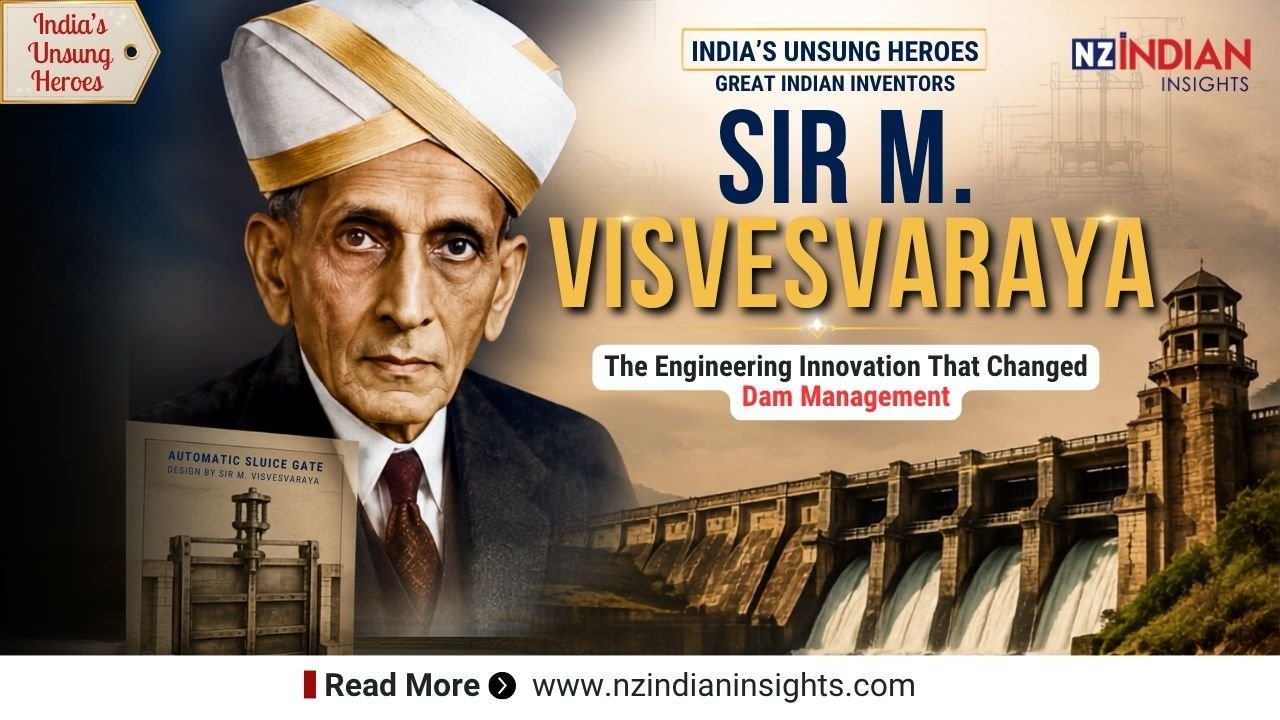
The story can focus on how Sir MV combined engineering innovation with practical problem-solving at a time when India was still developing its modern water-management infrastructure. His automatic water-flow regulation gates became one of his best-known engineering achievements, helping regulate reservoir levels without requiring constant manual operation.
When people think about India’s greatest innovators, names from the worlds of science, technology and medicine often come to mind. But some of the country’s most important innovations were created not in laboratories, but on dams, rivers, roads and construction sites.
One of those pioneering figures was Sir Mokshagundam Visvesvaraya, popularly known as Sir MV.
Related Post
Born in 1861, Visvesvaraya became one of India’s most respected engineers and administrators. His career was closely connected with some of the country’s most important challenges: managing water, improving irrigation, protecting communities from floods and developing infrastructure.
Among his best-known engineering achievements was his work on automatic water-regulating sluice gates, a technology associated with the Khadakwasla reservoir near Pune. The innovation helped demonstrate how engineering could be used to regulate reservoir water levels more efficiently while reducing the risk of uncontrolled overflow.
More than a century later, Sir MV’s story remains a powerful example of how practical innovation can have a lasting impact on society.
Who Was Sir Mokshagundam Visvesvaraya?
Sir Mokshagundam Visvesvaraya was born on 15 September 1861 in Muddenahalli, in present-day Karnataka.
He studied civil engineering and went on to build a distinguished career in public works and water engineering.
At a time when India was developing much of its modern infrastructure, engineers faced enormous challenges. Cities needed reliable water supplies, agricultural regions needed irrigation and growing populations needed protection from floods.
Visvesvaraya became known for approaching these problems with a combination of technical knowledge, careful planning and practical engineering.
His career included work with irrigation and water-supply systems, and he later played an important role in the development of the princely state of Mysore.
His contribution was not limited to one invention or one dam. It was part of a much broader vision of using engineering to improve everyday life.
The Water Management Problem
Controlling water is one of the oldest engineering challenges in human history.
Too little water can cause drought and threaten agriculture. Too much water can cause flooding, destroy crops and damage homes and infrastructure.
Reservoirs and dams provide a way to store and regulate water, but managing a reservoir safely requires careful control of the water level.
In the late 19th and early 20th centuries, many systems depended heavily on manual operation. Engineers therefore looked for ways to make water-control structures more responsive and efficient.
This was the environment in which Visvesvaraya developed one of his most famous engineering innovations.
The Automatic Sluice Gate Innovation
Visvesvaraya is widely associated with the development of an automatic sluice gate system designed to regulate the flow of water from reservoirs.
The basic engineering principle was relatively simple but highly useful.
Instead of relying entirely on people to monitor water levels and manually operate gates, an appropriately designed automatic mechanism could respond when the water reached a predetermined level.
When the reservoir level rose, the mechanism could allow excess water to pass through the outlet system. As the water level changed, the gates could respond accordingly.
This approach offered engineers a more controlled method of managing reservoir levels.
The significance of the idea was not simply the physical gate itself. It was the application of automatic regulation to water management at a time when mechanical automation was far less advanced than it is today.
Khadakwasla and the Early Demonstration
One of the projects most strongly associated with Visvesvaraya’s automatic gate system is Khadakwasla Dam near Pune.
The reservoir was an important source of water for the region, and managing its water level was a major engineering challenge.
Visvesvaraya’s automatic gate design was installed at the reservoir and became an important demonstration of the technology.
The gates were designed to help regulate the reservoir level and allow excess water to be released when necessary.
The success of the system helped establish Visvesvaraya’s reputation as an innovative engineer.
It also demonstrated an important principle that remains central to infrastructure engineering today: good engineering is not only about building structures; it is about making those structures respond safely and efficiently to changing conditions.
From Water Control to Wider Infrastructure
Visvesvaraya’s engineering career extended well beyond the automatic gates.
He worked on irrigation, drainage, water supply and flood-control projects and became associated with major infrastructure initiatives across India.
His expertise eventually took him to Mysore, where he served as the Diwan of Mysore from 1912 to 1918.
During this period, he supported industrialisation, education, infrastructure development and economic growth.
His vision was broader than individual engineering projects. He believed that modern infrastructure and technical education were essential to India’s progress.
That combination of engineering and nation-building became one of the defining features of his legacy.
Krishna Raja Sagara Dam: Engineering for Water Security
Another major project associated with Visvesvaraya is the Krishna Raja Sagara (KRS) Dam in Karnataka.
The dam was built across the Cauvery River and became an important part of the region’s irrigation and water-supply infrastructure.
Visvesvaraya played a significant role in the planning and development of the project.
The KRS project reflected the kind of engineering vision that defined his career: using large-scale infrastructure to address practical problems affecting agriculture, communities and economic development.
The reservoir also became an important source of water for the region around Mysore.
Why His Automatic Gates Were Important
The importance of Visvesvaraya’s automatic sluice gates lies in their practical purpose.
The technology helped engineers think differently about reservoir management.
Rather than treating a dam as a static structure, the system introduced a degree of automatic response into water regulation.
That concept is particularly relevant today.
Modern dams use sophisticated sensors, electronic monitoring, computerised controls and automated systems. Engineers can track rainfall, reservoir levels, river flows and weather conditions in real time.
Visvesvaraya’s work belongs to an earlier era, but the underlying engineering philosophy remains familiar: design infrastructure that can respond to changing environmental conditions.
Was Sir MV the World's First Inventor of Automatic Dam Gates?
Sir MV is sometimes described in popular accounts as the inventor of the world’s first automatic dam gates.
However, historical descriptions of water-control technology can be more complicated than a single “first inventor” claim.
Automatic and self-regulating water-control mechanisms had been explored in different forms before and during Visvesvaraya’s career.
A more accurate way to describe his contribution is that Visvesvaraya developed and successfully applied an automatic sluice-gate system that became an important engineering achievement in India’s water-management history.
This distinction does not diminish his achievement.
His work demonstrated how innovative mechanical engineering could be adapted to India’s specific water-management needs and used in major public infrastructure.
More Than an Engineer
Sir MV’s legacy cannot be understood only through dams and gates.
He was also an advocate for education, industrial development, scientific thinking and economic progress.
As an administrator, he encouraged modern industries and institutions in Mysore.
He believed that India’s development depended on technical skills and education.
His famous approach to life was closely connected with discipline, hard work and public service.
That philosophy helped make him a national symbol of engineering excellence.
A Legacy That Goes Beyond His Lifetime
Visvesvaraya lived during a period of enormous change.
India was moving toward modern industrial and infrastructure systems, while engineers were dealing with challenges that remain familiar today.
Flooding, water shortages, irrigation, urban growth and infrastructure resilience continue to affect communities around the world.
Climate change has also increased attention on extreme rainfall, flood management and water security.
In this context, Visvesvaraya’s work offers an important lesson.
Engineering is not simply about constructing bigger structures. It is about understanding a problem, designing a practical solution and creating infrastructure that serves society.
Why Sir M. Visvesvaraya Still Matters
There are several reasons Sir MV continues to be remembered more than a century after his major engineering projects.
1. He solved practical problems
His work focused on real challenges involving water, irrigation, flooding and public infrastructure.
2. He embraced innovation
The automatic sluice-gate system demonstrated his willingness to apply mechanical innovation to complex water-management problems.
3. He thought beyond individual projects
His vision included education, industrialisation, infrastructure and economic development.
4. His work had a public purpose
Much of his engineering career was connected to improving water access, agriculture and infrastructure for communities.
5. His philosophy remains relevant
His emphasis on discipline, technical knowledge and national development continues to inspire engineers and students.
Celebrating India’s Engineering Heritage
Sir Mokshagundam Visvesvaraya represents an important part of India’s engineering history.
His story also reminds us that innovation does not always arrive in the form of a famous consumer product, a laboratory breakthrough or a technology company.
Sometimes innovation is a mechanism hidden inside a dam.
Sometimes it is a water system that quietly protects a community.
And sometimes the person behind that innovation becomes known not because of fame, but because generations of people continue to benefit from the infrastructure they helped create.
That is what makes Sir MV such a fitting subject for India’s Unsung Heroes.
Conclusion: The Engineer Who Saw Water Differently
Sir Mokshagundam Visvesvaraya’s life was built around a simple but powerful idea: engineering should solve problems that matter to people.
From automatic water-regulating gates to major irrigation and infrastructure projects, his career demonstrated how technical knowledge could be turned into practical public benefit.
His achievements belong to a formative period in India’s engineering history, but the challenges he worked on have not disappeared.
Flood control, water conservation, irrigation and resilient infrastructure remain critical issues today.
More than a century after his pioneering work, Sir MV’s legacy continues to offer a valuable message to a new generation of engineers and innovators:
Great innovation is not only about creating something new. It is about creating something that makes life better.
That is why Sir Mokshagundam Visvesvaraya deserves his place among India’s great engineering pioneers—and why his story deserves to be remembered.

FAQs
Who was Sir Mokshagundam Visvesvaraya?
Sir Mokshagundam Visvesvaraya was a renowned Indian civil engineer, administrator and statesman. He is particularly remembered for his contributions to irrigation, water management, flood control and infrastructure development.
What did Sir M. Visvesvaraya invent?
He is widely associated with an automatic sluice-gate system designed to regulate reservoir water levels. The system was famously implemented at Khadakwasla near Pune and became one of his best-known engineering achievements.
Why is Sir M. Visvesvaraya famous?
Sir MV is famous for his contributions to water engineering, irrigation, flood management and infrastructure development. He also served as the Diwan of Mysore and promoted education, industry and economic development.
What is Sir M. Visvesvaraya's connection with Khadakwasla Dam?
Visvesvaraya developed an automatic gate system that was installed at Khadakwasla reservoir near Pune. The system helped regulate water levels and became an important example of his engineering innovation.
Why is Engineers' Day celebrated in India on 15 September?
India celebrates Engineers' Day on 15 September, the birth anniversary of Sir M. Visvesvaraya, in recognition of his contribution to engineering and nation-building.
Sir M. Visvesvaraya was more than a dam engineer. He was an innovator who used engineering to address some of India’s most important water and infrastructure challenges. His automatic sluice-gate technology and wider contributions remain an important part of India’s engineering heritage.
This article is part of NZ Indian Insights’ “India’s Unsung Heroes” series, highlighting Indians whose ideas, achievements and contributions have helped shape the country and the wider world.
Disclaimer: This article is for educational and informational purposes. Historical details and claims are based on available records and may vary across sources.