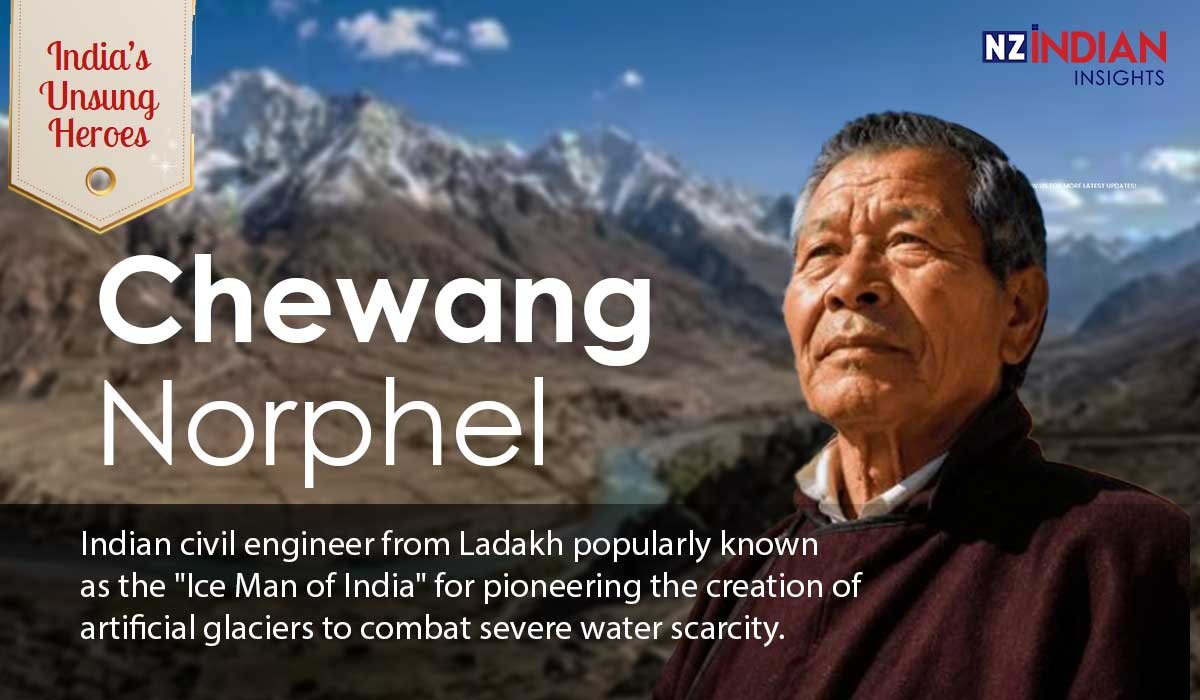
In the high-altitude deserts of Ladakh, where water scarcity threatens agriculture and livelihoods every year, one man transformed a simple idea into a life-changing innovation. Chewang Norphel, widely known as the Ice Man of Ladakh, pioneered the creation of artificial glaciers that store winter water for use during the dry spring months.
His remarkable work has helped thousands of people overcome seasonal water shortages while demonstrating how local knowledge and environmental innovation can solve complex climate challenges.
Who Is Chewang Norphel?
Chewang Norphel is an Indian civil engineer and environmental activist from Ladakh. After spending decades working in the region, he noticed a recurring problem-villages struggled with severe water shortages during the early growing season.
Related Post
Natural glaciers, the primary source of irrigation water, had been shrinking due to climate change and changing weather patterns. Farmers often had to wait until late spring or early summer for glacier meltwater, causing crop failures and reduced agricultural productivity.
Instead of accepting the problem, Norphel searched for an innovative solution.
The Birth of Artificial Glaciers
Rather than trying to stop glaciers from melting, Chewang Norphel developed a method to create artificial glaciers.
His approach involved:
- Diverting winter stream water into carefully selected shaded locations.
- Allowing water to spread across gently sloping terrain.
- Freezing the water layer by layer during Ladakh’s harsh winters.
- Creating man-made ice reservoirs that gradually melt in spring.
These artificial glaciers begin melting much earlier than natural glaciers because they are located at lower elevations, providing farmers with irrigation water precisely when crops need it the most.
How Artificial Glaciers Help Communities
Artificial glaciers have transformed water management in several Ladakhi villages.
Reliable Irrigation
Farmers receive water during the crucial planting season instead of waiting weeks for natural glacier melt.
Increased Crop Production
Timely irrigation has improved harvests, allowing communities to grow vegetables, barley, wheat, and other crops more successfully.
Reduced Water Scarcity
Villages that once experienced severe water shortages now have a more dependable seasonal water supply.
Climate Adaptation
Artificial glaciers provide a practical way for mountain communities to adapt to changing climate conditions without expensive infrastructure.
A Low-Cost, Sustainable Innovation
One of the most remarkable aspects of Chewang Norphel’s work is its simplicity.
His artificial glaciers require:
- Minimal machinery
- Local materials
- Community participation
- Very low maintenance
- No major environmental disruption
Unlike large dams or reservoirs, artificial glaciers work with nature instead of against it.

Recognition and Awards
Chewang Norphel’s contributions have earned national and international recognition.
Some of his notable honors include:
- The Padma Shri, one of India’s highest civilian awards.
- Recognition from environmental organizations for climate adaptation.
- International appreciation for sustainable water conservation techniques.
His work has inspired engineers, environmentalists, and policymakers around the world to explore nature-based solutions to water scarcity.
Why His Innovation Matters Today
Climate change is accelerating glacier retreat across many mountainous regions.
Countries throughout Asia, including India, Nepal, Pakistan, and Bhutan, face increasing concerns over freshwater availability.
Chewang Norphel’s artificial glacier model demonstrates that:
- Local innovation can solve global challenges.
- Traditional knowledge and engineering can work together.
- Sustainable water conservation is possible even in extreme environments.
- Communities can build resilience against climate change using affordable solutions.
Lessons from the Ice Man of Ladakh
Chewang Norphel’s story teaches valuable lessons:
- Observe local problems carefully.
- Use nature as part of the solution.
- Focus on practical, community-driven innovation.
- Small ideas can create lasting social impact.
- Sustainability often begins with simple engineering.
His achievements remind us that meaningful innovation does not always require advanced technology-it often starts with understanding people, nature, and local needs.
Chewang Norphel transformed the lives of countless families by turning freezing winter water into a reliable source of life during spring. His artificial glacier innovation has become a global example of sustainable water management and climate adaptation.
As water scarcity becomes an increasingly urgent global challenge, the work of the Ice Man of Ladakh continues to inspire governments, scientists, and communities seeking practical, environmentally friendly solutions.
His legacy proves that one person’s determination and creativity can leave a lasting impact on both people and the planet.
FAQs
Why is Chewang Norphel called the Ice Man of Ladakh?
He earned the nickname because he developed artificial glaciers that store winter water as ice and release it during the farming season.
How do artificial glaciers work?
Winter stream water is diverted into shaded areas where it freezes naturally, creating ice reservoirs that melt gradually in spring for irrigation.
Why are artificial glaciers important?
They provide early-season irrigation, improve crop production, reduce water shortages, and help communities adapt to climate change.
What award has Chewang Norphel received?
He was awarded the Padma Shri for his outstanding contribution to water conservation and environmental innovation.
Disclaimer: This article is for informational purposes only. While we strive for accuracy, readers should verify information from official and reliable sources.
From Indian pioneers and global innovators to environmental heroes and scientific breakthroughs, our Education Lens category brings you insightful stories designed to educate, inspire, and spark meaningful conversations.