
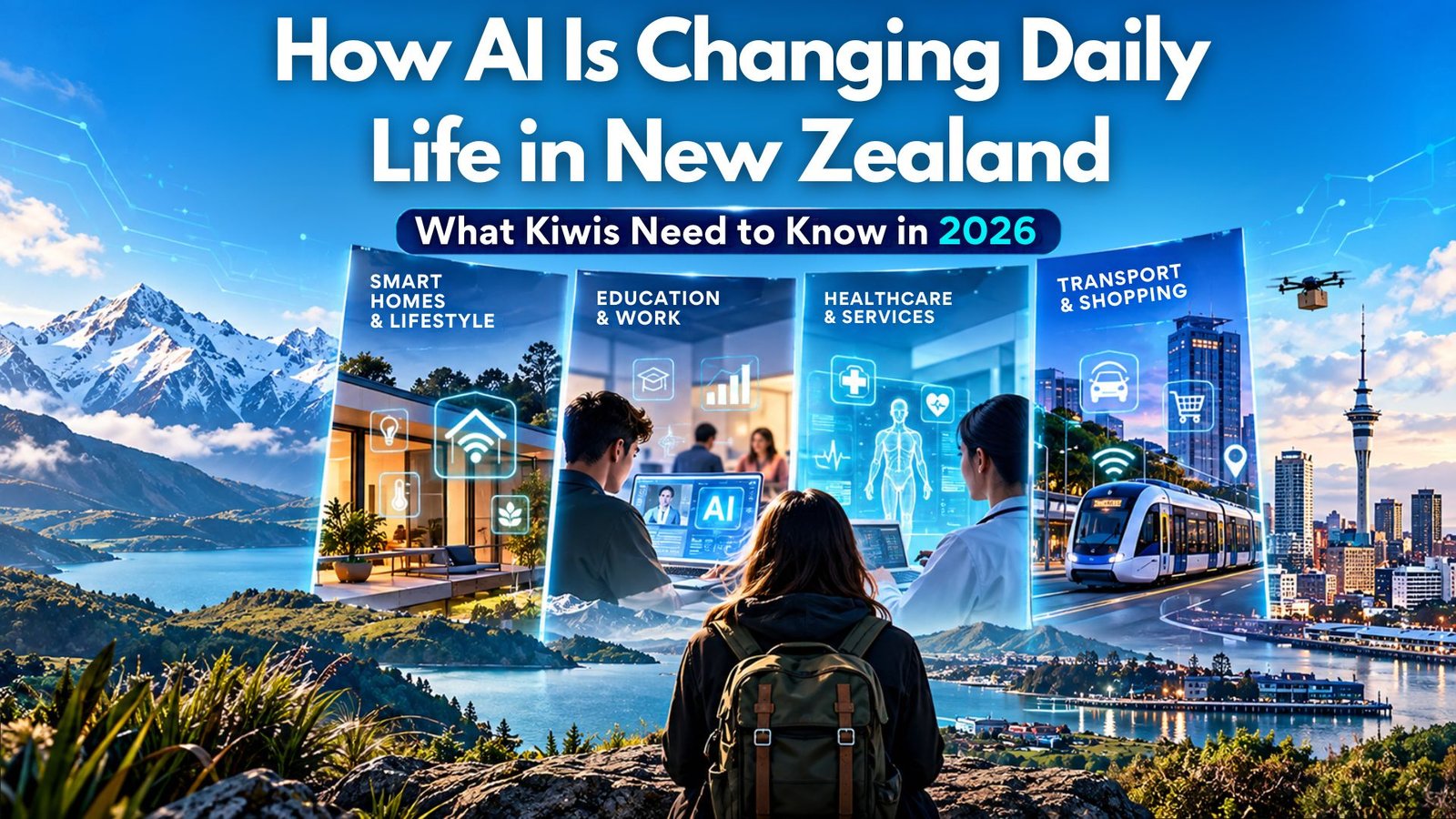
Artificial intelligence is no longer something that belongs only in science-fiction movies, technology companies or research laboratories. In New Zealand, AI is gradually becoming part of everyday life — often without people even noticing it.
From writing an email and planning a trip to helping businesses manage customers, supporting teachers and making digital services more efficient, artificial intelligence is changing how people work, learn and make everyday decisions.
For New Zealand, this change is particularly important. The country has a relatively small population and economy compared with major technology markets, but it has an opportunity to become a smart adopter of AI and use the technology to solve local problems.
Related Post
The New Zealand Government released its first national AI strategy in 2025, with a strong focus on encouraging businesses to adopt and use AI rather than trying to compete with the world’s largest AI model developers.
So what does this actually mean for an ordinary person living in Aotearoa?
AI Is Already Around Us
When people hear the words “artificial intelligence”, they may immediately think about ChatGPT or other generative AI tools.
But AI is much broader than chatbots.
AI can be found in search engines, recommendation systems, online shopping, banking tools, navigation apps, translation services, customer service systems and many other digital products.
For example, when a streaming service recommends a programme, a navigation app suggests a faster route or an online store recommends products, algorithms are helping decide what information appears in front of you.
Generative AI has taken this one step further by allowing people to interact with technology using ordinary language.
A person can ask an AI tool to explain a complicated topic, create a first draft of an email, organise ideas, summarise information or help with a business task.
The technology is therefore moving from being something people simply use in the background to something they actively interact with.
1. AI and Work: The Office Is Changing
One of the biggest effects of AI is likely to be in the workplace.
Employees are increasingly using AI tools to complete repetitive tasks, prepare documents, analyse information, generate ideas and improve communication.
A small business owner in Auckland, Christchurch or Hamilton, for example, could use AI to prepare a first draft of a social media post, organise customer enquiries or create an outline for a marketing campaign.
An office employee could use AI to summarise a long document or prepare a meeting agenda.
However, AI does not necessarily mean that every job will disappear.
New Zealand’s employment guidance notes that AI is more likely to support people by improving productivity across many tasks, although the way work is performed is changing.
This means an important question for workers is not simply, “Will AI take my job?”
A better question may be:
“How can I learn to work effectively with AI?”
Communication, problem-solving, creativity, judgement, leadership and people skills are likely to remain important because AI still needs human direction and oversight.
2. Small Businesses Could Benefit Significantly
AI could be particularly useful for New Zealand’s small-business community.
Many businesses do not have large marketing, technology or administration teams. A business owner may have to manage customers, accounts, social media, websites and day-to-day operations themselves.
AI can help reduce some of that workload.
A café could use AI to develop promotional ideas. A tradesperson could organise customer enquiries. A professional service provider could use AI to structure documents and research topics.
The Government’s AI strategy specifically encourages practical adoption by New Zealand businesses and provides responsible AI guidance for businesses.
For Kiwi-Indian business owners and professionals, this could create another opportunity to compete in a digital economy without needing a large technology department.
But businesses should not treat AI output as automatically correct.
Human review remains essential, particularly when AI is being used for financial, legal, immigration, employment or other sensitive information.
3. AI and Education: A New Challenge for Students
Education is another area where AI is already having a major impact.
Students can use AI tools to explain concepts, brainstorm ideas and practise learning. Teachers can also explore AI tools to support lesson planning and other educational tasks.
But there is an important difference between using AI as a learning assistant and allowing AI to do the learning for you.
New Zealand’s Ministry of Education advises schools to check AI-generated information because AI can produce convincing but incorrect answers. It also highlights privacy and cultural-bias concerns.
For NCEA students, the issue is even more important. Assessment work needs to represent the student’s own knowledge and skills, and generative AI has specific restrictions in assessment contexts.
For parents, the lesson is simple: AI should be discussed with children rather than treated as something mysterious.
Children need to learn how to question AI, check information and use technology responsibly.
4. AI Could Change How Families Manage Daily Life
AI’s impact does not stop at the workplace or classroom.
Families can use AI to organise schedules, create shopping lists, plan meals, compare ideas, learn new skills and simplify everyday information.
Imagine a busy family trying to organise school activities, work commitments, appointments and weekend plans.
An AI assistant could help organise information into a practical schedule.
But there is an important rule:
Convenience should not replace judgement.
If an AI tool provides health, financial, legal or other high-stakes information, people should verify it through reliable sources or qualified professionals.
AI can help people understand information, but it should not automatically become the final decision-maker.
5. AI and New Zealand's Public Services
AI is also moving into government operations.
A 2026 New Zealand Government survey found 59 public-sector organisations reported 545 AI use cases, compared with 272 use cases reported in 2025. The survey also found that 167 cases were already in operational phases in 2026.
The applications include administration, communications, policy work, project management and other functions.
For ordinary New Zealanders, the long-term goal could be faster and more efficient public services.
However, public trust will be critical.
People need to know when AI is being used, how their information is handled and where human oversight remains.
The Government’s AI approach emphasises responsible adoption, including considerations around privacy, security, fairness and safety.
6. Privacy Is One of the Biggest Issues
The more people use AI, the more important privacy becomes.
People sometimes enter personal information into AI tools without thinking about where that information may go.
This can include names, addresses, financial details, workplace information, private documents or information about children.
New Zealand’s Ministry of Education specifically advises users not to put personal, confidential or sensitive information into AI tools and highlights the need to understand how tools may use prompts and data.
A useful everyday rule is:
If you would not normally share the information publicly, think carefully before putting it into an AI tool.
AI can be extremely useful, but convenience should never come at the cost of privacy.
7. AI Must Work for New Zealand - Not Just the Rest of the World
There is another issue that deserves more attention: local context.
AI systems are trained using huge amounts of information from around the world. That does not mean they automatically understand New Zealand culture, communities or local circumstances.
The Ministry of Education has warned that AI systems can be weaker when dealing with mātauranga Māori, te reo Māori, Pacific languages and Polynesian cultures.
This is important for everyone living in Aotearoa, including migrant and multicultural communities.
For New Zealand’s Indian community, AI may also struggle with regional languages, cultural traditions, family structures, accents and experiences that are not strongly represented in training data.
That is why people should see AI as a tool rather than an unquestionable authority.
8. AI and Healthcare: Helpful, But Not a Doctor
Healthcare is another area where AI has enormous potential.
AI can assist with information management, administrative work, research and other healthcare-related applications.
For everyday users, however, there is a clear boundary.
An AI chatbot may help explain a medical term in simple language, but it should not replace a doctor, nurse or other qualified health professional.
People should be particularly careful about using AI to diagnose symptoms or decide whether medication or treatment is appropriate.
The convenience of an instant answer does not guarantee that the answer is medically correct or appropriate for an individual’s situation.
9. Will AI Make Life Better?
This may be the biggest question.
AI can save time.
It can help people work faster, learn differently and access information more easily.
It could help small businesses become more productive and help public organisations reduce administrative workloads.
New Zealand’s national AI strategy identifies productivity, innovation and economic opportunity as important reasons for increasing AI adoption.
But technology alone does not guarantee better lives.
If people become overly dependent on AI, stop checking information or share too much personal data, new problems can emerge.
The goal should therefore not be to use AI for everything.
The goal should be to use AI where it genuinely adds value.
10. What Should New Zealanders Do Now?
People do not need to become AI experts overnight.
A practical approach is to start small.
Learn how AI tools work. Try them on low-risk tasks. Check their answers. Understand privacy settings. Avoid entering sensitive information. And develop the habit of verifying important information.
For workers, learning how to use AI responsibly could become an increasingly valuable workplace skill.
For students, learning how to question and evaluate AI may be just as important as learning how to use it.
For businesses, creating clear internal rules around AI can reduce privacy, security and accuracy risks.
And for families, talking openly about AI can help children develop responsible digital habits.
The Future of AI in Aotearoa
Artificial intelligence is not arriving in New Zealand someday in the distant future.
It is already here.
The bigger story is how deeply it will become integrated into everyday life.
New Zealand’s approach is currently focused heavily on adoption — using AI to improve productivity and solve practical problems rather than attempting to build every major AI technology domestically.
That could give Aotearoa an opportunity to focus on what it does best: applying technology to local needs.
For Kiwi-Indian families, workers, students and business owners, the coming years could bring significant changes.
The most important skill may not be knowing everything about AI.
It may be knowing when to use it, how to question it and when a human should make the final decision.
AI can help us work faster.
It can help us learn.
It can help businesses grow.
But the future of technology in New Zealand should remain human-centred.
AI should be a tool that supports people — not a replacement for human judgement, relationships and responsibility.
Disclaimer: This article is for general informational purposes only. AI-generated information should be independently checked, particularly for health, financial, legal, immigration, education and other important decisions.
Explore more Technology Desk stories and practical insights from NZ Indian Insights.
FAQs
How is AI changing daily life in New Zealand?
AI is increasingly being used in workplaces, education, government services, online platforms, business operations and everyday digital tools. People can also use generative AI for tasks such as writing, learning, planning and organising information.
Is AI going to replace jobs in New Zealand?
Some tasks may become automated, while other jobs may change. Current New Zealand guidance suggests AI is likely to support productivity across many tasks, making AI skills and human capabilities increasingly important.
Is it safe to put personal information into AI tools?
People should be cautious. Personal, confidential and sensitive information should not be entered into AI tools unless there is a clear and appropriate reason and the privacy implications are understood.
Can New Zealand students use AI for schoolwork?
AI may be used as a learning support depending on school policies and assessment requirements. Students must ensure assessed work represents their own knowledge and skills. NCEA assessment has specific rules around generative AI.
What is the biggest benefit of AI for New Zealand?
One major opportunity is productivity. AI could help businesses, workers and public organisations complete certain tasks more efficiently while creating new opportunities for innovation.