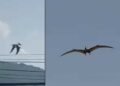

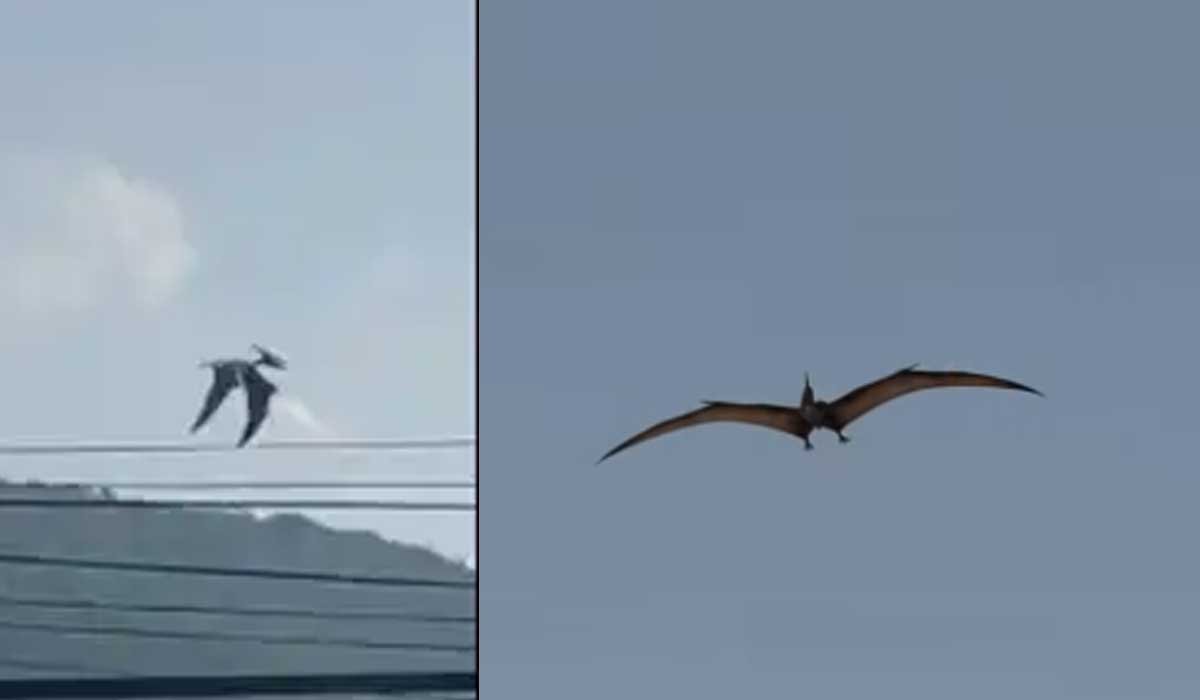
A mysterious flying creature captured in viral footage allegedly recorded in Mexico has sparked widespread online curiosity, with some social media users comparing its unusual shape to a pterodactyl. However, the extraordinary claim has been challenged by a palaeontologist, who has highlighted several reasons why the footage does not appear to show a genuine prehistoric flying reptile.
The videos have circulated online as viewers attempt to identify the large, dark figure moving across the sky. While the creature’s silhouette has attracted attention, experts have urged people to look beyond appearances and consider the scientific evidence before accepting the footage as real.
The discussion also highlights a growing challenge in the digital age: distinguishing authentic recordings from manipulated or artificially generated videos.
Related Post




What Is Behind the Viral Pterodactyl Sighting in Mexico?
The viral footage reportedly shows a large, winged figure flying above a residential area in Ciudad Juárez, in Mexico’s Chihuahua state. Its outline, long-looking body and broad wings have led some viewers to suggest that it resembles a pterosaur, a group of prehistoric flying reptiles that lived millions of years ago.
As the clips spread across social media, users began debating whether the mysterious figure could represent an animal that had somehow survived from prehistoric times.
The unusual appearance of the creature has fuelled speculation, but a video alone cannot establish the identity of an animal. Low image quality, unusual camera angles, lighting conditions and digital editing can all make familiar objects appear unfamiliar.
Some online discussions have suggested that the creature might be a large bird rather than an extinct reptile. Other viewers have questioned whether parts of the footage were created or modified using artificial intelligence.
The key issue is not simply whether the figure looks unusual. It is whether the recording provides reliable evidence that supports the extraordinary claim.
Why a Palaeontologist Questions the Footage
A palaeontologist who reviewed the circulating footage raised concerns about the creature’s movements, physical appearance and apparent resemblance to known prehistoric animals.
One important observation involves the way the figure appears to move its wings. Large flying animals use different combinations of flapping and gliding, depending on their anatomy, size and flying conditions.
The expert questioned whether the repeated wing movements shown in the video were consistent with what would be expected from a large pterosaur. The movement appeared unusual enough to raise doubts about the creature’s authenticity.
Its visual appearance was another concern. The figure seems smooth and scaly in the footage, while scientific research has established that some pterosaurs had hair-like coverings known as pycnofibres. The exact covering varied among species, making it important not to assume that every pterosaur looked identical.
The expert also questioned the apparent identification of the animal as a Pteranodon, a well-known group of large pterosaurs whose fossils are associated with ancient marine environments in North America.
Taken together, these observations led the palaeontologist to reject the footage as credible evidence of a living prehistoric reptile.
Although individual visual clues may be difficult to assess in a short or unclear clip, the broader scientific evidence does not support the conclusion that pterosaurs still exist today.
Could the Creature Be a Large Bird?
One possible explanation discussed online is that the unusual silhouette could belong to a large bird filmed from an awkward angle.
Birds can appear dramatically different when viewed from below, particularly when their wings, necks and bodies overlap against a bright or dark sky. Distance can also make it difficult to judge an animal’s actual size.
A large wading bird, such as a heron, has a distinctive body shape and extended neck that can create an unusual silhouette during flight. Depending on the angle and quality of the recording, these features might be mistaken for characteristics associated with a prehistoric flying reptile.
However, identifying the animal conclusively would require clearer footage and a reliable examination of its shape and movements. Without that evidence, it would be premature to declare exactly what every clip depicts.
It is also important to distinguish between different videos circulating under the same viral claim. Similar-looking clips may have different origins, and evidence that one recording has been manipulated does not automatically establish the history of every other video.
For now, the available footage has not demonstrated that a pterosaur was flying over Mexico.
The Role of Artificial Intelligence in Viral Videos
The controversy comes at a time when AI-powered image and video tools are making it easier to create convincing-looking scenes that never happened.
Modern generative tools can produce realistic animals, landscapes and moving objects. Some videos may look believable at first glance, even when closer inspection reveals inconsistencies.
In one widely circulated version of the Mexico creature footage, fact-checking analysis identified apparent changes and distortions in lettering on a building. Such inconsistencies can be warning signs of AI-generated or digitally altered content.
Other potential clues include unnatural movement, changing object shapes, inconsistent shadows, distorted backgrounds and details that appear differently from one frame to another. None of these signs alone proves that a video is fake, but together they can justify closer examination.
Viewers should also remember that ordinary compression, poor lighting and camera movement can produce visual errors in genuine recordings. Responsible verification requires looking at the complete context rather than relying on a single suspicious detail.
The growing accessibility of AI video tools makes it increasingly important to verify sensational claims before sharing them.
What Science Says About Pterodactyls
The word “pterodactyl” is commonly used to describe prehistoric flying reptiles, although it is often applied loosely to several different kinds of pterosaurs.
Pterosaurs were not birds or dinosaurs in the strict scientific classification. They were a separate group of flying reptiles that lived during the Mesozoic Era and developed specialised wings supported by an elongated fourth finger.
Their fossils have helped researchers understand their anatomy, flight adaptations and diversity. Some species were relatively small, while others had enormous wingspans and specialised feeding habits.
Pterosaurs disappeared around 66 million years ago, near the end of the Cretaceous Period, during the mass extinction that eliminated many groups of animals.
There is currently no credible scientific evidence demonstrating that pterosaurs survived into the modern era. A genuine discovery of a living population would require exceptionally strong evidence, such as independently verifiable footage, physical specimens or other scientific material that could be examined by specialists.
A dark shape moving across the sky, without supporting evidence, does not meet that standard.
Local Authorities and the Importance of Verification
Reports about the alleged sighting have also drawn attention in Mexico. Local civil protection officials in Ciudad Juárez have reportedly dismissed the circulating videos as entertainment content without a credible basis.
Such responses reinforce the need to separate online speculation from verified information. Viral posts can spread rapidly across platforms, often reaching large audiences before experts have an opportunity to examine the underlying material.
When a claim involves an extraordinary animal sighting, viewers should look for confirmation from recognised scientific institutions, credible local reporting and qualified researchers.
The absence of an official scientific investigation does not, by itself, prove that every detail in a video is false. However, it does mean that viewers should avoid presenting the claim as an established discovery.
A responsible report should clearly distinguish what a video appears to show, what experts have concluded and what remains uncertain.
How to Check Whether a Viral Video Is Genuine
Before sharing an unusual animal sighting, consider a few simple verification steps.
Check the original upload: Find the earliest available version of the clip. Reposted videos may remove important context or add misleading captions.
Look for independent confirmation: Check whether reputable news organisations, researchers or relevant authorities have independently verified the event.
Examine the details: Watch for inconsistent movement, distorted backgrounds, changing objects and other visual irregularities. Treat these as clues rather than automatic proof of manipulation.
Use reverse searches where possible: Screenshots and key frames may help identify older footage or reveal whether a clip has been reused in a different context.
Be cautious with extraordinary claims: A discovery that would transform established scientific understanding requires much stronger evidence than a short, unexplained social media video.
These steps can help viewers make more informed decisions without dismissing every unusual recording outright.
Why the Mexico Video Has Captured Attention
Stories about prehistoric creatures continue to fascinate people because they connect modern life with a world that existed millions of years ago. The possibility of seeing an animal associated with ancient history can be an exciting idea, particularly when a video appears to offer visual proof.
Social media encourages this fascination by allowing unusual clips to reach audiences around the world within minutes. Dramatic captions and speculative comments can further increase interest, even when the evidence is weak.
But popularity should never be confused with proof. A video can attract millions of views without establishing that the event depicted actually occurred.
The Mexico pterodactyl controversy is a reminder that curiosity and critical thinking should go together. Asking questions about an unusual sighting is reasonable; accepting an extraordinary explanation without evidence is not.
Final Verdict: No Verified Evidence of a Living Pterodactyl
The viral footage allegedly showing a pterodactyl flying over Mexico has attracted widespread attention, but the claim has not been supported by credible scientific evidence.
A palaeontologist has questioned the creature’s movements and appearance, while the possibility of a large bird or digitally manipulated footage has also been raised. Certain versions of the circulating video have reportedly shown signs consistent with AI generation or editing.
At present, the footage should not be treated as proof that a prehistoric flying reptile has survived into the modern world.
The episode offers a useful lesson for anyone following viral news: pause, check the evidence and look for independent verification before sharing a sensational claim.
For more science, technology and trending news, follow NZ Indian Insights.