
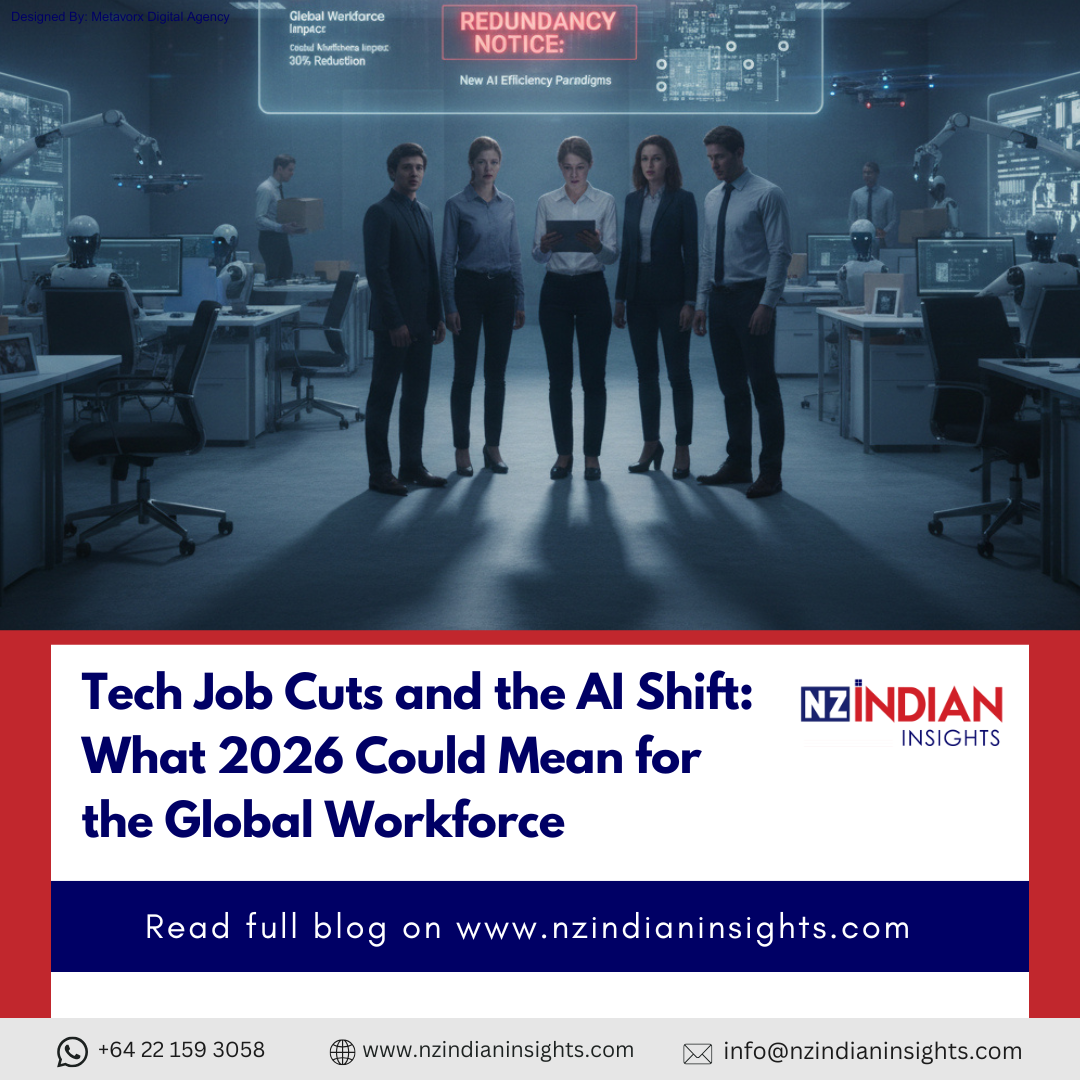
Artificial intelligence is no longer a future concept in workplace discussions — it is already influencing how companies hire, restructure, and plan ahead. As the world moves closer to 2026, the relationship between AI adoption and tech employment is becoming more defined, shifting from speculation to real-world transformation.
Recent job cuts across the global tech industry have signalled a deeper change underway. Rather than pointing to a collapse in employment, experts suggest 2026 will highlight a recalibration of roles, skills, and expectations as AI becomes central to daily business operations.
Why Workforce Reductions Are Likely to Continue in 2026
Tech companies are approaching 2026 with a more cautious and efficiency-driven mindset. The era of rapid hiring and unchecked expansion has given way to a focus on sustainable growth.




Several developments are influencing this shift. AI systems that once supported human teams are now capable of managing entire operational segments, especially in areas such as quality testing, data handling, customer queries, and routine software tasks. At the same time, rising investment in AI infrastructure has increased pressure on companies to optimise costs elsewhere. This has encouraged organisations to redesign teams by combining multiple functions into fewer, technology-assisted roles.
As a result, job cuts expected in 2026 are likely to be selective rather than widespread, impacting positions centred on repetitive, predictable tasks rather than those requiring judgement, creativity, or leadership.
AI’s New Role: From Innovation Tool to Business Backbone
By 2026, artificial intelligence is expected to move firmly into the role of a core business system rather than an experimental add-on. For many organisations, AI will underpin decision-making, operations, and productivity tracking.
This evolution is driving changes in how teams are structured. Companies are increasingly favouring smaller groups of highly skilled professionals who can manage, interpret, and improve AI-driven processes. Productivity benchmarks are also shifting, with greater emphasis on outcomes rather than hours worked.
Instead of replacing people outright, many employers are redefining jobs so employees supervise AI systems, refine outputs, and apply human judgement where automation falls short.
Roles That Are Evolving Instead of Vanishing
While layoffs often dominate headlines, the reality for 2026 suggests transformation is more common than elimination. Many tech roles are changing in scope rather than disappearing entirely.
Software developers are expected to work closely with AI-powered coding tools, focusing more on architecture and problem-solving than manual writing of code. Data professionals are moving away from routine reporting towards validating insights and interpreting results. Product and project roles are becoming more strategy-driven, while IT support positions are shifting towards automation oversight and system reliability.
At the same time, new demand is emerging for professionals in areas such as AI ethics, governance, cybersecurity for automated systems, and specialists who can apply AI responsibly in sectors like healthcare, finance, education, and public services.
How Professionals Are Preparing for the 2026 Job Market
As organisations adapt, workers are also reassessing how they build long-term careers in tech. By 2026, the ability to adapt is proving just as valuable as technical qualifications.
Many professionals are prioritising continuous learning rather than relying on a single degree or certification. Learning to collaborate with AI tools, rather than resisting them, has become a key advantage. Transferable skills such as critical thinking, communication, and system-level understanding are increasingly important across roles.
This shift holds particular significance for younger workers and international professionals entering the workforce during a period of structural change.
Toward a More Sustainable Tech Industry
Despite ongoing concerns around layoffs, analysts suggest that 2026 could bring greater balance to the tech sector. After years of aggressive expansion followed by abrupt job cuts, companies are now aiming for stability built on realistic growth and long-term planning.
AI is not expected to replace human creativity, leadership, or cultural awareness — qualities that remain essential for innovation and ethical decision-making. Instead, it is redefining how work is performed and how value is created in modern organisations.
What the Future of Work Looks Like Beyond 2026
The rise in tech job cuts linked to AI reflects a broader economic and technological transition. As 2026 approaches, the narrative is shifting away from fear toward preparation and adaptation.
While some roles will continue to fade, new opportunities are opening for those willing to evolve alongside technology. The future of work is not a contest between humans and machines, but a test of how effectively they can work together in an increasingly AI-driven global economy.
Disclaimer:
This article is for informational and editorial purposes only. It does not constitute career, financial, or employment advice. Employment trends may vary by industry, region, and organisation. Readers are encouraged to seek professional guidance when making career-related decisions.